Category Archives: Our current Lebenswelt is not the Lebenswelt that we evolved in
Human psychology evolved under in the social milieu of constrained complexity. Currently, humans live in unconstrained complexity. What has this done to our minds? These topics are addressed in various parts of An Archaeology of the Fall, particularly in chapters 8C and 11B.
0025 Hazony points to the obvious. Humans evolve in social circles where there are many relationships between a more powerful individual and a less powerful one, starting with mom, dad and their children. The organizational structure of this foundational institution is discussed in A Primer on the Family.
0026 The family starts in the Lebenswelt that we evolved in. So, there is more.
We must add the unconstrained social and labor specializations that characterize our current Lebenswelt.
Our current Lebenswelt is not the Lebenswelt that we evolved in.
0027 The organizational structures of civilizationB is a topic worthy of consideration. The institutionaC and sovereignbClevels of the society tierC contextualize the organization tierB. The organization tierB encompasses productionaB, exchangebB and assessmentcB. The organization tierB emerges from (and situates) the individual in communityA.
Too bad inquiry into the organization tierB is yet to be initiated.
Advancements are blocked by marxist theory, in its various guises. Marxist theory offers a “scientific” model that forecloses intellectual exploration of the organizations tierB.
0028 The model goes like this:
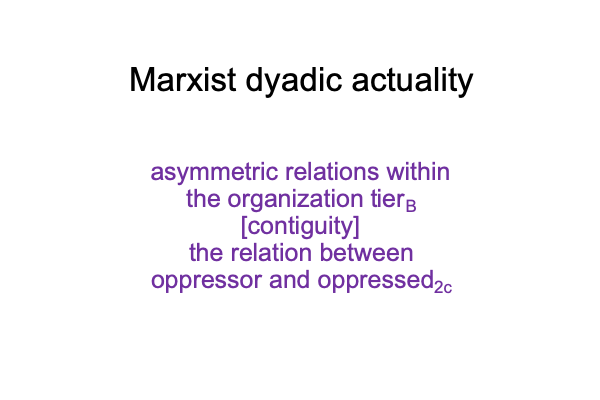
The diverse relations between more powerful and less powerful individuals in the organization tierB are equivalent to the relation between oppressors and oppressed.
The two are more than equivalent. They are contiguous.
Figure 8
0029 What does contiguity imply?
Peirce’s category of secondness consists of two contiguous real elements. The contiguity is not a real element, it is the substance that causally binds the two real elements. The marxist substance carries the character of equivalence, but that is not enough. Ask any marxist. The causality is systemic.
Anyone who disagrees speaks with what Jacques Lacan calls, the master’s discourse. Here is the oppressor.
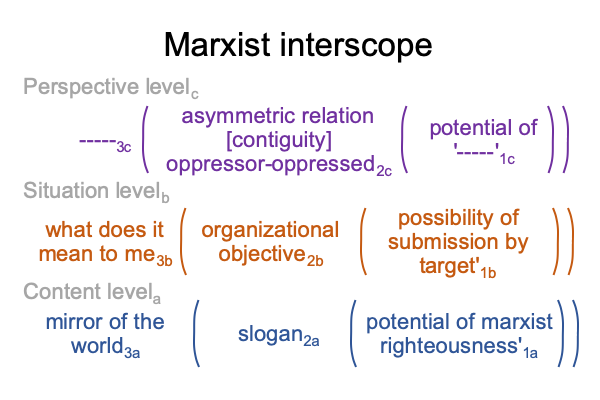
Anyone who agrees speaks, to me3b, in discourses that Lacan labels, hysteric (for some) and scientific (for others). For the most part, I find it hard to tell the difference. I suppose the label depends on the slogan2a. Each slogan2a addresses the one who asks what does this mean to me3b.
“Me3b” is a placeholder, virtually situating the person’s reflection3b in the marxist mirror of the world3a.
0030 Oppressed? Or oppressor? Find a location within the abundance of asymmetric relations contained within the organization tierB.
Here is a diagram of the marxist interscope, as far as this discussion sees.
0031 From the masterwork, How To Define the Word “Religion“, one finds that there are three tiers to the presence underlying the word, “religion”.
They are the societyC, organizationB and the individual in communityA.
The society tierC puts the organization tierB into perspective. The organization tierB emerges from (and situates) the individual in communityA.
Each tier is diagrammed as a three-level interscope.
0032 So, let me talk business.
When an young individual in communityA enters the organization tierB, by going to work, “he” engages a number of asymmetric relations.
How does a young personA navigate these relationsB?
Obviously, the individual in communityA relies on what “he” has been taught.
0033 American classical liberals teach that the individual should have a dream2a.
French classical liberals instruct the individual with tropes about equality, freedom and human brotherhood2a. These expectations2a encourage asymmetric business relations to be “win-win”.
Marxist (il)liberals indoctrinate slogans raising awareness of how asymmetric relations between individuals somehow cause (are contiguous with) systemic oppression2a.
0034 Liberalism offers a dream. Marxism offers a nightmare. Choose your false consciousness.
0035 Hazony describes the pairing as a dance. In this dance, one party negates the other. Thus, the dance is more like the mating ritual between the male and the female praying mantis. The dance ends when liberalism gets devoured as food for the fertilized egg sacs of marxism. Afterwards, an all-consuming fecund marxism dies from her own contradictions, in the winter of her totalizing reign.
0036 Why do I say this?
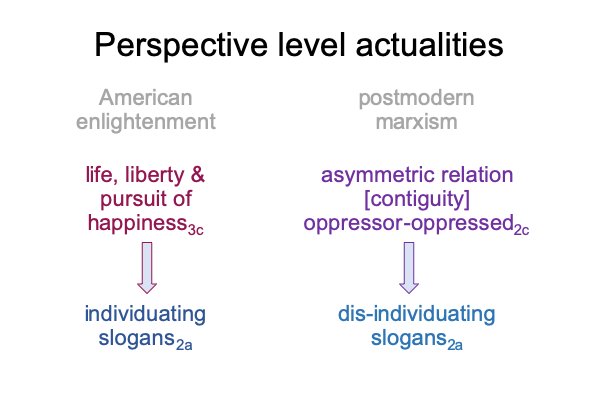
Compare the perspective-level actualities2c for American enlightenment and postmodern marxism.
Figure 10
0037 When the American enlightenment is reflected in the mirror of the world3a, slogans2a call for individuation1b. The asymmetric relations characterizing the organization tier are depicted as opportunities and hazards for fashioning a dream2a based on one’s talents and dispositions1a. When confronted with oppressors, the individual should learn how to detect, avoid and escape. When confronted with mentors, the individual should figure ways to flourish.
0038 Indeed, in America, opportunities1b for success are manifold, ask any movie actress2b promoted by the notorious Harvey Winerock, who turns out to be a postmodern marxist2a,b,c.
In contrast, millions of less-promoted actresses now live in movies of their own, the comedies and tragedies of life in the family2aB, the traditional portal to the organization tierB. For every one actress who reaches an accommodation2b with Harvey, by playing through his disgusting game1b, millions of women discover that the asymmetric relations inherent in the family realize2b their dreams2a.
Who should be teaching whom?
Surely, a Hollywood actress stands in asymmetric relation to innumerable mothers, among others.
So, what does she preach?
Marxist slogans2a?
Why?
In order to attain her dream2b, she is required to become so oppressed2c that she cannot recognize herself as an oppressor2c. She lives out the scientific truth of marxism2c. She submits1b and receives both rewards and marxist illumination2b.
0039 Why are so many civic institutions of American liberalism now controlled by marxists?
The marxist perspective translates the asymmetric relations of the organization tierB into the languages of oppressor and oppressed. Mirroring this perspective2c, slogans2a emerge from a righteousness1a that demands submission of the oppressors1b. One party in all asymmetric relationsB is already guilty of oppression1a on the basis of participation in the system. That party cannot be the marxist, who represents the oppressed.
By definition, the oppressed2c, such as Harvey Winerock and the Hollywood actress, are exempt because each is a marxist occupying a powerful position in a once civic, now marxist, institution. Each, in his and her own way, is a victim in an asymmetric relation with a more powerful individual.
For the actress, that more powerful individual is Harvey.
For Harvey, that more powerful individual is the one who bought his soul.
0040 Harvey Winerock is the poster boy of the marxist endgame.
Here is a character at home with the cruelty of the organization tierB, where asymmetric relations among individuals is contiguous with systemic oppression. Harvey stands as a gatekeeper for the studios of Hollywood. He is a gargoyle. Actresses and actors must speak the proper slogans2a and submit to the proper humiliations1b in order to pass into the bewitched enclave where every asymmetric relation stinks of systemic exploitation. Welcome to an institution filled with marxists.
0041 Harvey lives the marxist dream.
Until, of course, he does not.
Why?
Others can play the game. The organization tierB changes, every so slightly. The identification of oppressor and oppressed2c shifts out of his favor. Harvey and the actress point fingers in a house of mirrors.
0042 Hazony writes of marxism as the end of democracy.
It is really the end of sanity.
Why do French liberals (aka, “old time democrats”) and American liberals (aka, “tea party republicans”) find common cause in 2020?
They both gaze into the house of mirrors that is postmodern modernism.
There is one encouraging feature about the current scene. American academics, hatching the mantis eggs of the Frankfurt school, succinctly articulate their ever-expanding agendas. Hazony comes close to appreciating the paradox, where any asymmetric relation within the organization tierB may be interpreted as systemic oppression2c. If this actuality2c is true and if the organization tierB is full of asymmetric relations (not just full, but bursting with them), then systemic oppression2c is everywhere, except for once-liberal institutions under the control of marxists2b.
0043 What a joke.
InstitutionscC contextualize organizationsB. InstitutionscC justify organizationsB on the basis of righteousness2a. Marxists act as if they are institutionscC without the trappings of an organizationB. Yet, organized they are. They demand sovereign power3b in order to achieve the organizational goals2b that actualize their slogans2a. Harvey Winerock and the movie actress both exemplify the exceptional character of marxists. They are exempt from the marxist critique2c because they self-identify as marxists.
Harvey is promoted by other marxists within the studio system, just as homosexual priests promote their confreres, actresses promote their marxist causes, and public school teachers protest for better wages, in order to get better working conditions. No, nobody here engages in asymmetric relations that characterize the organization tierB. Instead, the avatars of the “be little men” movement say that men must become aware how systemic oppression is built into their life, their liberty and their pursuit of happiness.
No, marxists cannot see their reflections in the mirror of the world3a, because their illumination2c is supposed to be reflected in the mirror of the world3a. They see their illuminance2c, not themselves, in their slogans2a.
0044 Academic postmodern marxist disciplines are inquiries into how this or that asymmetric relation in the organization tierB somehow causes (is contiguous with) a relation between oppressor and oppressed2c. Marxists destroy once-liberal civic institutions from within, simply by identifying and promoting others who are self-identified victims (and extollers2a) of particular types of systemic oppression2c. Indeed, their organizational objectives2b force others into submitting1b to slogans2a that assign guilt for participation in systemic oppression1a.
0045 Ultimately, sovereign power3b is required in order to promulgate their organizational objectives2b. And, this is the ultimatum that Hazony fears. What happens when marxists gain control of the levers of state power?
Yoram Hazony’s article is an intimation of what will be exposed when conservative, Christian and nationalist citizens challenge Big Government (il)Liberalism, the hidden and the complete perversion of the Enlightenment tradition.
0046 Five related works are available at www.smashwords.com.
A Primer on the Category Based Nested Form
A Primer on Sensible and Social Construction
How To Define the Word “Religion”
A Primer on the Family
A Primer on the Organization Tier (First and Second)
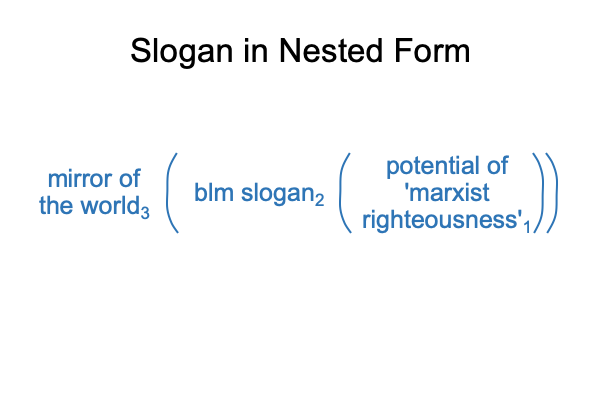
0001 Sociology is often a curious field of inquiry. In the mirror of the world3, there is only one Be Little Men movement (blm). Blm is a slogan2. No substitutions to these words are allowed. The potential1 underlying the slogan2 is fixed on the only possibility among a sea of possible meanings, presences and messages. That potential is the possibility of marxist righteousness1.
Here is a picture of a triadic relation, as introduced in A Primer on the Category-Based Nested Form.
Figure 1
0002 What is marxist righteousness1?
Marx is a “communist” who names his enemy, the “capitalist”.
The specter of “capitalism”?
Das Kapital?
The root word for “capital” is “head”.
Wrap your cap around that.
0003 Marxist righteousness1 relies on the emptiness of spoken words. A speech-alone word is merely a placeholder in a system of differences. Meaning, presence and message must be projected into each spoken word. The marxist reserves the right to project that meaning, presence and message.
Allow no substitutes.
Substitutions squander the purity of the projection.
0004 What does this mean to me3?
This is what the target of a marxistslogan never asks.
The slogan isolates the guilty.
Originally, the capitalist is the one upon which marxist righteousness descends. The target is guilty, with no option of managing the label, except through submission1. Indeed, the organizational objective2 is to manifest submission1.
Now, other labels serve as slogans2a.
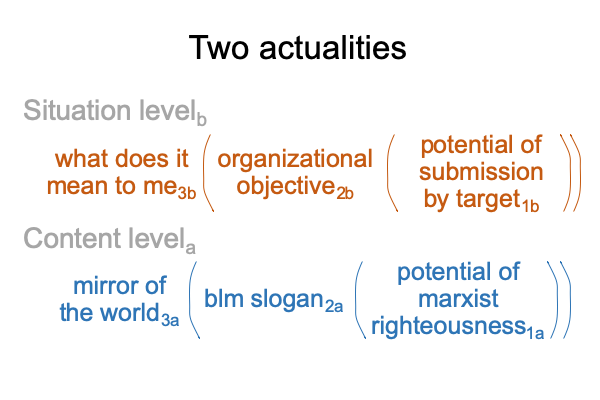
This second nested form situates the first nested form, as described in A Primer on Sensible and Social Construction.
Figure 2
0005 There are two blms. On the content level, blm is a slogan2a emerging from (and situating) righteousness1a. On the situation level, blm manifests organizational objectives2b that actualize the potential of submission1b, thus increasing the wealth, power and overall prowess3b of those reflecting the mirror of the world3a.
According to rumors, advertisers in saavy suites say that executive suits of major corporations donate large sums1b to an organization2b whose namesake is the slogan2a. Other, less well-endowed targets are suited up as scapegoats, following the historic and literary patterns noted by Rene Girard. Marxist righteousness projects a lack, held within the accuser, upon a scapegoat, the target.
0006 Yes, by definition1a, certain types can never submit1b. These characters are magically gifted with the power to create the lack that they are accused of1a as well as the standing to fill that lack with their own… shall I say?.. capitals1b.
0007 Is marxism a modern version of an ancient religion?
Surely, early civilizations sacrifice humans to their gods.
Remember the old adage?
A capitalist will sell the communist the rope to hang himself.
The joke works as long as the target does not comprehend the intent of the customer.
Why would anyone hang the fellow who sold “him” some rope?
Marxist righteousness calls the fellow, a “capitalist”.
The seller’s hanging manifests the realness of the marxist’s organizational objectives1b.
In the same way, ritual sacrifice validates the realness of ancient deities.
0008 What else does this imply?
The target is not privy to what does this mean to me3b. The deadly earnestness of marxist submission1b cannot be appreciated from the outside. The above two-level interscope is sensible only from the inside. The insider holds the secret knowledge3a that secures the slogan’s single possible meaning, presence and message1a.
If a gnostic path blossoms into a social movement, such as the be little men movement, then today’s secular academic sociologists include the topic in their regional and global meetings, showcasing how they are in tune with the emerging secret knowledge. They can explain it. They can write books about it. They can explore its righteousness1a, explicate its slogans2a, develop pathways for submission1b and extol its authority2b. They can conduct surveys in order to show how a slogan has struck a cord in social consciousness3a. They can tell all how the insider feels3b.
0009 Modern sociology is such a curious field of inquiry. It poses as a mirror3a ofthe worldc. As such, it constructs its own sensible approach, in the same fashion as marxist religions.
0010 Five related works are available at www.smashwords.com.
A Primer on the Category Based Nested Form
A Primer on Sensible and Social Construction
How To Define the Word “Religion”
Comments on Eric Santner’s Book (2016) “The Weight of All Flesh”
Comments on Peter Burfeind’s Book (2014) Gnostic America
To date, it seems that Catholics have flown a white flag to scientism, especially when it comes to human evolution. Nicanor Austriaco, O.P., strikes back, in a 2018 article appearing in the American Catholic Philosophical Quarterly. This well-trained biologist delivers a blistering attack on the anti-essentialism of science.
Strangely, he locates an essence for the human in a 2016 book by two modern academics. Why Only Us? is authored by two Harvard professors, Robert Berwick and Noam Chomsky. The first works on computer models for language. The second is a famously political linguist.
Comments are in order. However, in a blink of an eye for the world of academics, Marie George flexes her erudition by taking Austriaco to task on his interpretations of Thomas Aquinas. She hands the Dominican a tar baby of scholastic qualifications.
Academic quarrels do not get better than this. Instead of one commentary, three are necessary, one for Marie George, one for Nicanor Austriaco OP, plus one for Berwick and Chomsky. The category-based nested form and the first singularity offer insights not available to any of these authors.
Christians need not defend Adam against Darwinism. Rather, Christians have an option that reveals Adam within an evolutionary framework. This is the drama of An Archaeology of the Fall. This is the hypothesis of the first singularity. Our current Lebenswelt is not the Lebenswelt that we evolved in.
The following are available at www.smashwords.com.
Comments on Nicanor Austriaco’s Essay (2018) “Adam After Darwin”
Comments on Marie George’s Essay (2020) “Aquinas’s Teachings on Concepts and Words”
Comments on Robert Berwick and Noam Chomsky’s Book (2016) “Why Only Us?”
He asks, “How will sociology eventually face topic of evolution?”
Well, at the moment, sociology does not face up to evolution. In this, it ignores two important points. First, social organization does not explain itself. Second, social organizations are historical, therefore one must account for novelty and genuine change on the macro-level.
Chattoe-Brown proposes that Agent-Based Models may provide paths to packaging evolutionary theory for sociology.
In the next blog, I comment on this article. I place these comments on my blog in order to introduce intrepid students and teachers to the style of the masterworks and commentary available at Smashwords.com. The methodology is synthetic. The results are astounding.
The comments on Chattoe-Brown’s essay start with a question, asking, “What does a sociologist mean by the word, ‘evolution’?”
Is evolution only about genetic changes over time?
Or, does evolution pertain to civilization and history?
What is the logical structure of evolution?
These are good questions.
For example, in economics, there is a clear connection between prices and sales. Is this connection an adaptation? If so, what is the niche?
For example, in sociology, there is a clear connection between “something that makes sense to me” and “the answer to the question, ‘what am I supposed to do?’”. Is this connection an adaptation? If so, what is the niche?
The comments in the next blog track Chattoe-Brown’s argument into the thicket of Agent-Based Models. Institutions behave like individual humans. They try to figure out normal contexts and potentials. Agent-based models allow the inquirer to see parallels between the relational structures of organizations and individuals in community.
The comments touch base with three master-works.
The master-work, The Human Niche, argues that our genus adapts into the niche of triadic relations. If this is so, then humans think in terms of triadic relations, such as the category-based nested form. Do current agent-based models account for this? Yes, they are structured according to category-based nested forms.
The master-work, An Archaeology of the Fall, proposes that our species underwent a fundamental cultural transition during the past 7820 years. The first singularity potentiates unconstrained social complexity. This is precisely what Sociology studies.
The master-work, How to Define the Word “Religion”, opens the door to inquiry into our current Lebenswelt. Clearly, our current Lebenswelt is not the same as the Lebenswelt that we evolved in. Sociology investigates our current Lebenswelt.
In the long run, Sociology has no choice but to be evolutionary.
Sociology has a choice as to how to approach evolution. Is it only a biological process? Or does evolution follow a particular logic? If so, then that same logic may apply to social change. The category-based nested form may well be integral to how Sociology finds value in evolutionary concepts.
This work examines an article by Edmund Chattoe-Brown, appearing in the Frontiers in Sociology (26 Feb 2019, https://doi.org/10.3389/fsoc.2019.00006). My comments rely on the category-based nested form and other relational models within the tradition of Charles Peirce.
‘Words that belong together’ are denoted by single quotes or italics.
Prerequisites: A Primer on the Category-Based Nested Form, A Primer on Sensible and Social Construction
Recommended: The Human Niche, An Archaeology of the Fall, How to Define the Word “Religion”, Two Primers on the Organization Tier, Speculations on Thomistic Evolution
— Table of Contents
Introduction and Conclusion 0001
Cheese in the Middle 0004
The Sandwich is Firm 0010
Evolution and a Cheese Sandwich 0022
Conclusion 0029
— Introduction and Conclusion
0001 Edmund Chattoe-Brown opens with an observation.
Sociology, as an academic discipline, tends to rule out evolutionary approaches.
Surely, sociologists want to avoid any connection between social behavior and genes. Or, should I say, society and genetics?
Why?
First, it is not polite.
Second, anthropologists have already thrown in with Darwin. Archaeologists are convinced of the importance of evolution in understanding where the world comes from and how humanity comes to be. Any sociologist interested in evolution can go into anthropology.
Consequently, sociologists face a choice whether or not to adopt evolutionary approaches.
0002 Edmund Chattoe-Brown concludes his essay, asking “What can evolutionary accounts do for sociology?”
For one, let us not put the cart before the horse. Sociology is not to be at the service of evolutionary accounts. Just the opposite, evolutionary accounts should make sociology “fun”. Sociologists should not walk on eggs when discussing evolutionary accounts.
But, what is an evolutionary account? Descent with modification? Natural selection? Or does it always reduce to biology, innate dispositions and the reading of gene sequences?
For two, today, sociology is a jumble of eclectic approaches, making it difficult to define a disciplinary core. What kinds of analysis do sociologists engage in? Non-quantitative historical sociologists rely on one toolbox. Social statisticians work from another, quantitative toolbox. One provides diachronic insights. The other offers synchronic results.
Well, evolutionary accounts have similar specializations. For example, diachronic radionuclide dating of fossils and synchronic genetic surveys complement one another.
For three, evolutionary analysis is able to lay a foundation for both diachronic and synchronic approaches.
But, obviously, such evolutionary analysis is not biological. Genes will have nothing to do with unifying sociological evolutionary theories.
So, what does the term, “evolution”, mean to sociology?
0003 I suppose that evolutionary analysis is like a horse, at the service of sociology. Also, sociology is like a cart, held up by a wheel on either side. One wheel is historical and qualitative. The other wheel is statistical quantitative analysis.
Chattoe-Brown sits in the driver’s seat of this horse-pulled cart, driving out of the barn of the introduction and conclusion.
— Cheese in the Middle
0004 Okay, my metaphors are goofy. I hope that that will be a source of comfort and entertainment.
Chattoe-Brown’s introduction and conclusion act like two slices of bread. In the middle, he places the Agent-Based Model (ABM).
The idea of an agent appeals to the theoretical inclinations of the historical sociologist.
The ABM allows the narrow numerical focus of the statistical side of sociology.
Does that mean that the ABM will contribute to evolutionary approaches?
I defer an answer.
0005 I ask, “How does the ABM fit into the category-based nested form?”
In order to answer, I draw upon A Primer on the Category-Based Nested Form and A Primer on Sensible and Social Construction. These short pieces are enough to build a bridge between an ABM and an evolutionary approach.
0006 What does it mean to be an agent?
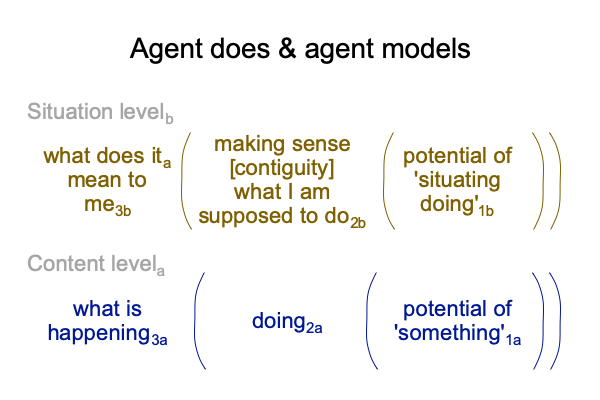
Well, an agent does “things”, broadly defined. These things are actions that, ideally, can be qualitatively observed and quantifiably measured. A bare-bones survey asks three questions. What is happening? What are you doing? Why are you doing what you are doing?
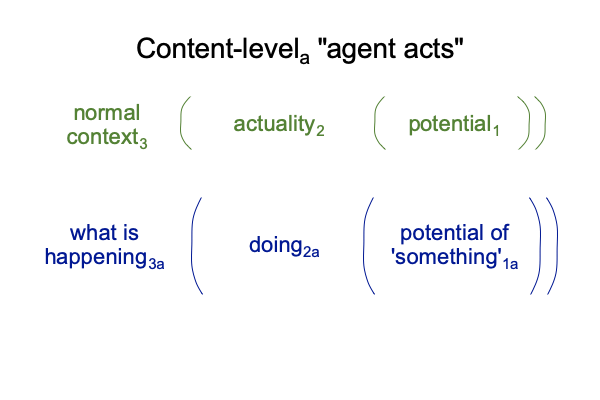
In the synchronic moment, an agent acts2, in the normal context of what is happening3, upon the possibilities inherent in accomplishing ‘something’1.
Here is a picture of this content-level nested form.
Figure 1
0007 What does the term, “agent-based model” indicate?
Well, an agent does things. What is happening3 defines the content levela of an interscope.
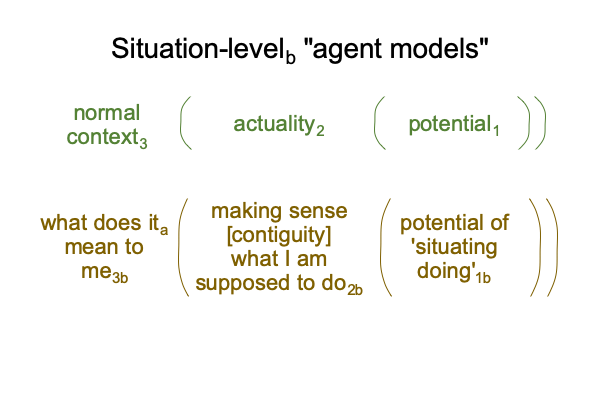
In addition to what is happening3a, an agent has the potential1 to situatebwhat he or she is doing2a. This assessment1brelies on what I am supposed to do2b. This assessment2b occurs in the normal context of what does it mean to me3b.
For sensible construction, what I am supposed to be doing2b better make sense2b. These elements are both real and contiguous.
Here is a picture of this situation-level nested form.
Figure 2
0008 The situation-levelbactuality2takes on the complete, dyadic structure of Peirce’s secondness. The category of secondness is the realm of actuality. Secondness consists of two contiguous real elements. For the agent who models “his” own actions, the two real elements are making sense2b and what I am supposed to do2b.
The nomenclature looks like this: making sense2b [contiguity] what I am supposed to do2b.
The term, “contiguity”, typically means contact, attachment, dependency, sharing, holding together, two closely timed events and so forth. Contiguity expresses causation, in the broadest sense.
The empirical sciences try to relate contiguity to material or force-field causation. For example, iron filings on a sheet of paper align to the magnetic field of a magnet beneath the paper. A magnetic field causes the iron filings to align. The notation is magnet [contiguity] iron filings. The contiguity is the magnetic field. The contiguity is the point of interest for physicists. They aim to mechanically and mathematically model this field.
What about the contiguity between making sense2b and what I am supposed to do2b?
The contiguity between these two real elements is yet to be articulated.
Still, the sociological imagination should already be engaged. Humans always make sense2b of what they are supposed to be doing2b, even when their behavior makes no sense at all, to a so-called “disinterested” observer.
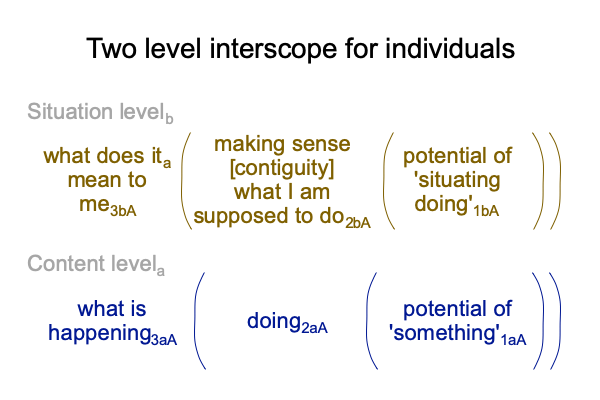
0009 Situationb virtually emerges from (and situates) contenta.
Together, they compose a two-level interscope.
Sensible construction is the hallmark of the two-level interscope.
Here is a picture of these two levels.
Figure 3
— The Sandwich is Firm
0010 So far, I imagine that an agent is an individual in community.
I am disabused of this notion with Chattoe-Brown’s first example. The agent is a business firm.
Does a firm fit the picture of what an agent does2aand what an agent models2b?
Well, I suppose some translation is necessary.
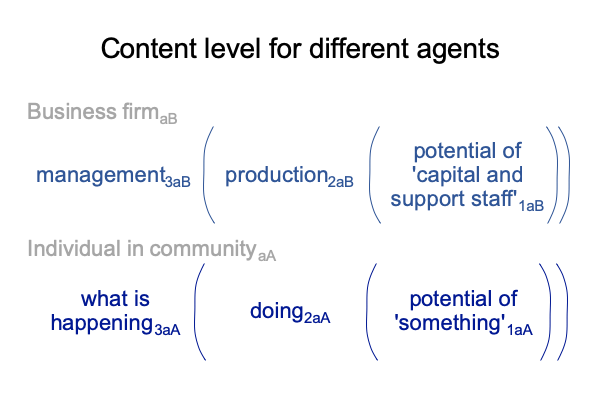
0011 I start with the content level.
How does a business firm compare to an individual in community?
Here is my guess.
Figure 4
0012 The business firm obviously belongs to a different tier than the individual in community. The relation among tiers follows the same pattern as the interscope. The organization tierB emerges from (and situates) the individual in community tierA.
Nevertheless, there are parallels in the relational structures.
Management3aB ought to know what is happening3aA in the firm. Sometimes, it3aB does not.
Production2aB strives to accomplish what must be done2aA. This necessitates cooperative action. Cooperative action increases productive capacity.
Does management2aB know this?
If they don’t, then human resources1aB should tell them3aB. If the firm is not running smoothly, capital1aB is not put to best use.
There is a certain irony in the location of both labor support1aB and capital1aB. Typically, labor associates to production2aB, the actualization of financial capital1aB. However, labor2aB also comes with its own human capital1aB, which may or may not be utilized by a firm3aB.
Surely, this is an opportunity for sociological research. What is the nature of human capital1aB? Can human capital1aB be treated in a fashion that complements financial capital1aB?
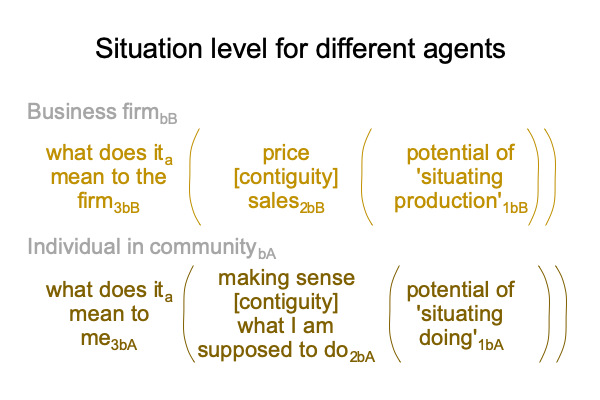
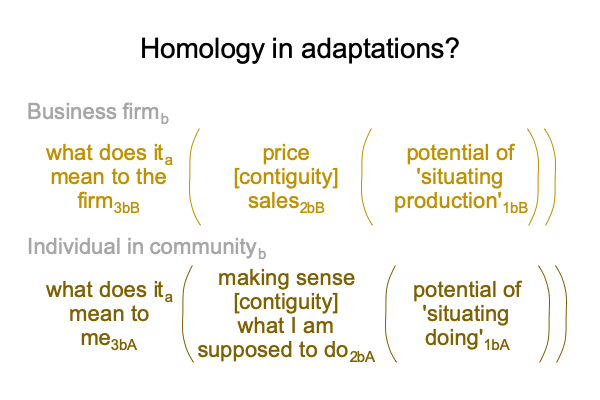
0013 What about a comparison of the situation levels between the firmbB and the individual in communitybA?
Figure 5
0014 This comparison touches base with Chattoe-Brown’s example of sales and price.
The firm3bB places products2bB onto a market1bB. If the products do not sell2bB at a given price2bB, then the situation becomes dire for the entire firm. In 1950, the economist, Armen Alchian, discusses a discontinuity between individualsAand firmsB. The stakes are higher for firms, even though no one dies when a firm goes bankrupt.
Yes, the death of a firm seems so much larger than an individual’s fate. Many individuals have done what they are supposed to do2bA, working at the firm3aB. Suddenly, the firm no longer makes sense2bA. A dream becomes a nightmare.
0015 The market is like an actuality independent of the firm.
Can a firm be considered an adaptation into a market niche?
Does that sound evolutionary?
What is a niche?
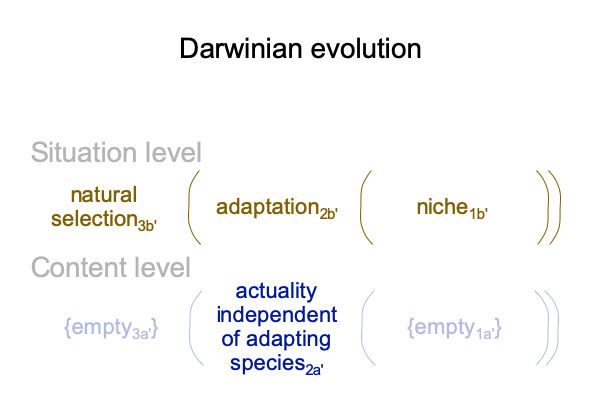
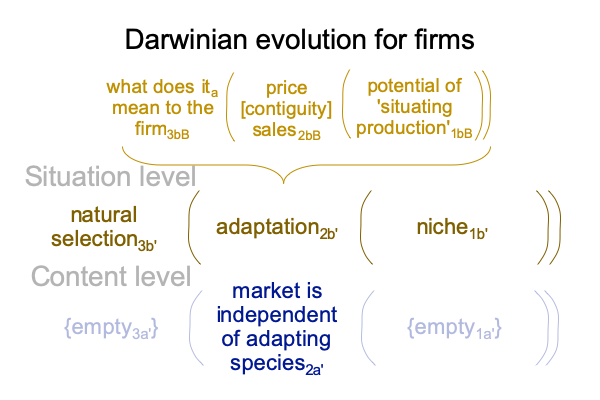
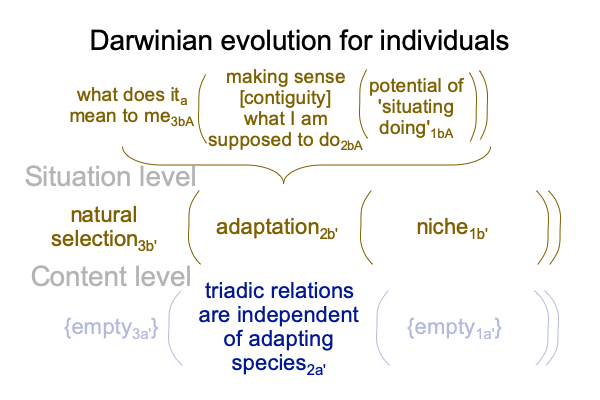
The following diagram presents Darwinian evolution as a sensible construction.
Figure 6
0016 The normal context of natural selection3b’ brings the actuality of an adaptation2b’ into relation with a niche1b’. A niche is the potential1b’ of an actuality independent of the adapting species2a’.
By comparison, a firm is an adapting species. The actuality independent of the adapting species2a’, is the market. The market2a’ is as changable as an evnironment2a’ or ecology2a’. However, the biological terms do not capture the character of the market2a’, because the market is both material and immaterial. The market plays upon what is real and what is imagined. The Germans formulated a word that captures the market2a’ as a quixotic being. The term is “Zeitgeist”.
Time is real. Ghosts are unreal.
No wonder ancient civilizations worship the space between earth and heaven. The god of the air, the wind, the cloud and the storm works under various names, including Yaltaboath. Yaltaboath behaves like the actuality underlying the niche that any corporation adapts to. Is Yaltaboath the personification of the open market’s multiplicity of specializations? What about the market’s creative destruction?
0017 And, what about the times before civilization?
What about the era before business firms?
Is our current Lebenswelt the same as the Lebenswelt that we evolved in?
Consider An Archaeology of the Fall.
Okay, that’s a plug.
The contemporary firm belongs to our current Lebenswelt.
0018 Chattoe-Brown’s example of the firm as an agent-based model brings me right to the threshold of evolutionary theory. The civilizational Zeitgeist is as fickle as Yaltaboath. Change is in the air we breathe. Yet, at the same time, each civilizational Zeitgeist lasts long enough to establish firms and profit from their endeavors. Yaltaboath rewards as well as punishes. Attending to this god makes sense.
0019 So, let me go back to the previous figure. Let me summarize.
How does natural selection3b’ work?
An actuality independent of the adapting species2a’ exists.
This actuality2a’ has a potential that can be exploited by the adapting species1b’. This potential is called the niche1b’.
An adaptation2b’ exploits its niche1b’, leading to increased reproductive success in natural selection3b’.
0020 How does the business firm, as an agent-based model, fit into this picture?
The situation-level of the firm is the adapting species2b’. The market is the actuality independent of the adapting species2a’. So, the niche1b’ is the potential of the market2a’.
Here is how that looks.
Figure 7
0021 So, the content-levela of the firmB does not even appear in an evolutionary approach. It is as if the abilities of management3aB, production2aB and support staff1aB are assumed to be functional. The sales department1bB situates its product2aB as something that offers an advantage in the current market1b’. Every product2aB fills a market niche1b’.
Just as every adaptation is a guess about how to exploit a niche, every firm speculates about the market that operates independently of the firm.
Of course, this must be a first approximation. A second approximation will be required, because the presence of the firm itself may alter the market.
— Evolution and a Cheese Sandwich
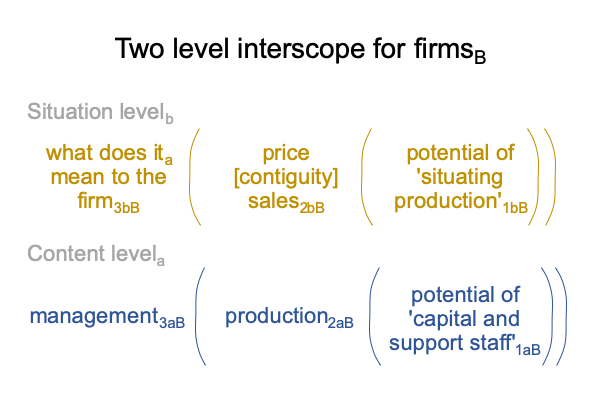
0022 So far, the agent-based model is the cheese between the bread of the introduction and the bread of the conclusion. As it turns out, the agent-based model may be re-articulated as a two-level interscope. The two-level interscope is synchronic. The two-level interscope expresses sensible construction. The two-level interscope belongs to the organization tierB, which has parallels to the individual in community tierA.
Here is how that looks for firms.
Figure 8
0023 Plus, there is a diachronic, evolutionary twist.
For firms, the entire nested form for the situation levelb goes into the slot for adaptation2b’ in Darwinian evolution.
Here is how that looks.
Figure 9
0024 If sociology has no choice but to be evolutionary, then this double vision cannot be avoided.
The situation-level of a firmbB must be analyzed as it emerges from (and situates) its corporate content-levelaB. To me, this analysis includes synchronic data and time-restricted models, typical of quantitative sociology.
The situation-level of a firmbB must also be pictured as an adaptation2b’ into a market niche1b’, where the market2a’ is (on first approximation) independent of the adapting species. (The second approximation brings in the idea of niche construction). This drama is depicted in historical sociology.
Surely, the double vision cannot be resolved into one, even though both start with the relational structure of the agent-based model.
0025 With this said, I proceed to Chattoe-Brown’s second example of agent-based modeling: foraging.
He dwells for three sections on a case study for foraging for food.
Perhaps, the simulation applies to elk, in addition to ancestral hominins.
Is that a far cry from firms?
After all, the agent-based model starts with a two-level interscope of individuals in community.
Here is how that looks.
Figure 10
0026 This raises an odd question, “Does the individual adapt, in the Lebenswelt that we evolved in, in the same way as the firm adapts in our current Lebenswelt?”
In our current Lebenswelt, the firmb’ adapts to the potential of the market2a’. The market offers rewards (and punishments) in the milieu of unconstrained social complexity. The behavior of a firm allows agent-based modeling to the extent that the Zeitgeist remains sensible.
Does this parallel human evolution?
0027 Consider the key hypothesis presented in the masterwork, The Human Niche.
In the Lebenswelt that we evolved in, the situation level of the individual in communityb’ adapts to the potential1b’ of triadic relations2a’. Triadic relations offer opportunities for sign-coordinated cooperative actions. Surely, the milieu is constrained social complexity. The innate behavior of individuals allows agent based-modeling to the extent that ecology remains stable.
Here is how that looks.
Figure 11
0028 This raises interesting questions.
Do markets2a’ and triadic relations2a’ have common characteristics?
My impression?
The more diverse the market and the more diverse the sign-relations, the greater the “wealth” of organizationsB and individuals in communityA, respectively.
0026 Is there a homology between the adaptations of firms and individuals in community?
Here is a comparison of the two situation-level nested forms.
Figure 12
0027 My impression?
A sale2bB matches what I am supposed to do2bA.
A price2bB points to making sense2bA.
What about the potential of situating production1bB?
The sales department echoes an individual trying to situate what “he” is doing1bA.
No wonder everyone seems to be selling themselves.
The resonances multiply.
Individuals in communityA enter into the market2a’.
Individuals in communityA also enter into management3a, production2a and support for a corporation1a.
So, the organization tierB and the individual in community tierA are entangled.
0028 Does that suggest that Chattoe-Brown’s cart is going out of its lane or that the cheese sandwich melts?
No. But, it does imply that genetics has nothing to do with the way sociologists investigate the organization tier.
Of course, biologists confound genetics and evolution. They apply for grants on the grounds that genetics solves questions in evolution. It does. But, there is always another, often ignored, side to biological evolution. That side is Darwinian natural selection.
Chattoe-Brown’s exercise in computer models concludes that both the environment and genetic-dispositions are in play in the evolution of foraging strategies. However, these “genetic-dispositions” are not phenotypes, they are adaptations.
Geneticists can eat their cake and have it too. Their cake is phenotypes. But, they claim that phenotypes are the same as adaptations.
Sociologists must approach evolution in terms of Darwinian natural selection. Institutions are adaptations.
— Conclusion
0029 Is there a disciplinary core to sociology?
According to Chattoe-Brown, not at this time.
Chattoe-Brown is an enterprising sociologist. He tries to sell agent-based modeling as the portal to evolutionary approaches. The gambit works because agent-based modeling is a symptom of human evolution and a feature of the organization tier.
Human evolution occurs in the Lebenswelt that we evolved in, as illuminated in The Human Niche.
The organization tier differentiates from the society andthe individual tiers in our current Lebenswelt, as portrayed in How to Define the Word “Religion”.
The transition from the first Lebenswelt to the second is a unique, prehistoric event, the first singularity, as captured in the fiction, An Archaeology of the Fall.
0030 Chattoe-Brown anticipates that evolution will provide a disciplinary core to sociology.
He may be correct in ways that he does not currently imagine.
There may be a parallel between the evolution of firms in our current Lebenswelt and the evolution of humans in the Lebenswelt that we evolved in.
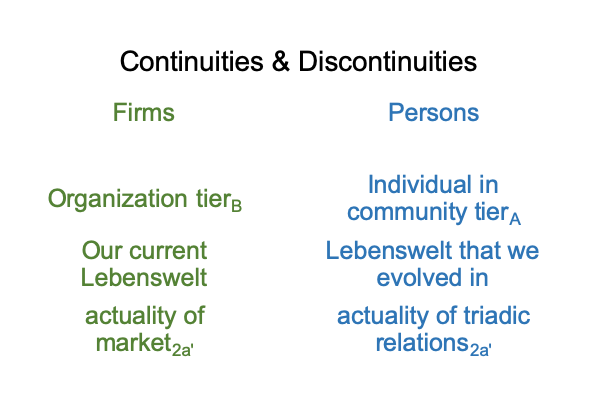
Here is a short list of comparing firmsB and individuals in communityA.
0001 These comments are offered on my blog as a sample of the character of works that are available for sale at www.smashwords.com. They seem rather dry and technical. Nevertheless, they offer an innovative postmodern approach that should interest enterprising students and scholars. Here, the category-based nested form and the two-level interscope come into play.
These categorical structures are introduced in A Primer on the Category-Based Nested Form and A Primer on Sensible and Social Construction.
0002 J.B. Stump offers his views in the March issue of Perspectives on Science and Christian Faith (volume 72(1), pages 15-24). Perspectives is the flagship publication of the American Scientific Affiliation. Stump’s article may be available for download at their website. If not, please request.
Stump addresses the question, “Did God guide our evolution?”
He reviews several broad ways to answer, then discusses his favorite.
0003 So, does God guide our creation?
What about the scientific description of human evolution?
These questions point in different directions, C2 and C1.
The second direction (C2) is that God intentionally creates human beings in His image.
The first direction (C1) claims that evolution is the best scientific explanation for the origin of our species, Homo sapiens.
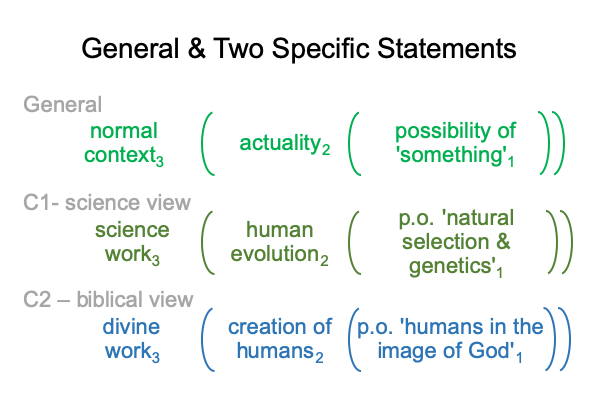
0004 These two claims can both be formulated as category-based nested forms (CBNF).
The CBNF contains four expressions. The fourth is paradigmatic. A normal context3 brings an actuality2 into relation with the possibility of ‘something’1. The subscripts refer to Peirce’s categories.
0005 Now, I associate features in each direction to the CBNF.
The normal context3 for C1 is science3. The normal context3 for C2 is the Genesis portrayal of God’s work3.
The actuality2 for C1 is human evolution2 and for C2 is the Genesis creation of humans2.
The potential1 for C1 is ‘natural selection and genetics’1. The potential1 for C2 is ‘the picture of humans as images of God’1.
0006 Here is how that looks in technical notation.
0007 So, did God guide our evolution?
According to Stump, the first strategy (A1) for answering the question relies on semantics.
I ask, “What problem does semantics solve?”
Well, I see two nested forms. How do they interact?
0008 Normal contexts follow the logic of exclusion, alignment and complement.
If they exhibit the logic of exclusion, the nested forms come into conflict. It’s God’s work3 or science work3. It is either one or the other.
If the logic is complement, then one could end up with Steven Gould’s idea of “non-overlapping magisteria”. This is not much of a complement. Perhaps, a truce is a better description.
If they exhibit the logic of alignment, then one nested form virtually emerges from (and situates) the other. This structural relation is called a “two-level interscope”. The two levels are contenta and situationb. Contenta goes with Peirce’s category of firstness (the realm of possibility). Situationb associates with Peirce’s category of secondness (the realm of actuality).
The two-level interscope has two flows.
In the upward flow, contenta underlies situationb.
In the downward flow, situationb orders contenta.
0009 So, I have two statements (C2 and C1) and two levels. Which goes with which?
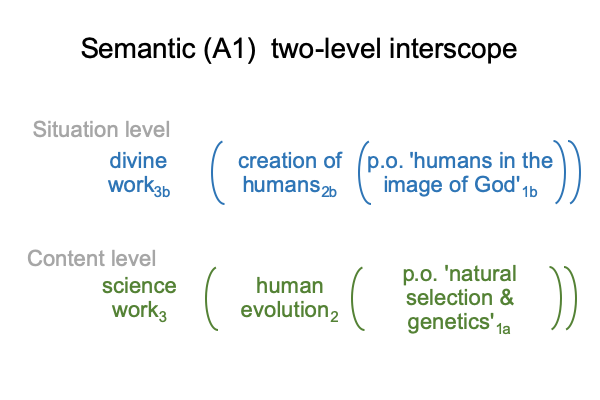
Here is where semantics comes into play. Semantics is about language. When I talk about science, my words are usually content-oriented. When I think about God’s creation, I am contemplating my own (and everyone else’s) situation.
There is another, more technical semantic argument. The religious statement (C2) cannot be situated by the science statement (C1), because the Positivist’s judgment rules out metaphysics. The Positivist’s judgment is developed in Comments on Jacques Maritain’s Book (1935) Natural Philosophy. I cannot help but smile at this application. From a semantic point of view, how could science situate a nested form that it cannot consider?
Here is a picture of the semantic-ordered, two-level interscope.
Figure 2
0010 Ironically, this model initiates questions that key into Stump’s second answer, the nomological strategy (A2). The nomological strategy suggests that the laws of human evolution are not well understood. The laws of evolution may be, but there is something wrong with their application to human evolution. Stumps reviews some critical arguments.
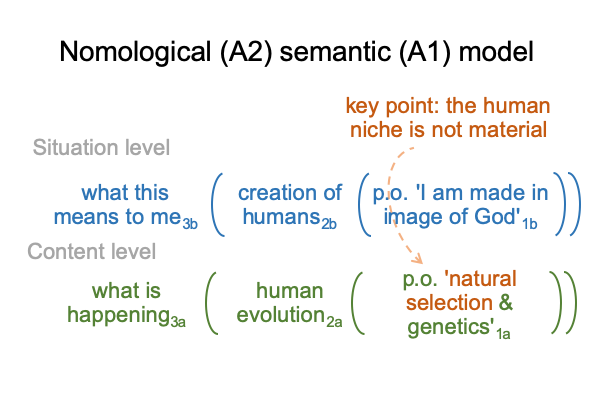
0011 The two-level interscope pictured above endorses the “yes, but” character of the nomological approach, addressing the question, “Did God guide human evolution?”
If science is so smart, then it should situate the religious nested form, rather than the other way around. The fact that the Positivist judgment excludes metaphysics indicates that science can understand human evolution only in terms of material and instrumental causalities. However, I personally situate the evolution of my species in terms of my religious sensibility, which involves immaterial causalities, such as final attributes and formal design.
What does this imply?
The ultimate human niche is not material.
Indeed, this is the central thesis of the masterwork, The Human Niche, available at www.smashwords.com.
0012 The semantic (A1) strategy may be adjusted by the nomological (A2), producing something like this.
Figure 3
0013 Well, if our hominin ancestors adapted over millions of years into a niche that is not material, then the third answer, the causal joint strategy (A3), comes into play. The causal joint strategy suggests that God does not obviously intervene in human evolution, but God nevertheless creates. The question is, “How?” Stump considers several authors with very curious answers.
0014 These answers have something in common.
They exploit the dynamics of the two-level interscope.
The divine situationb guides the science contenta.
The scientific contenta underlies divine subtle interventionb.
“Subtle” means “below the threshold of detection”.
0015 How could this happen?
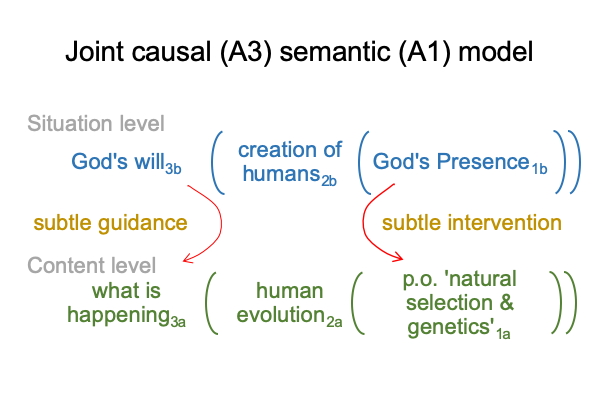
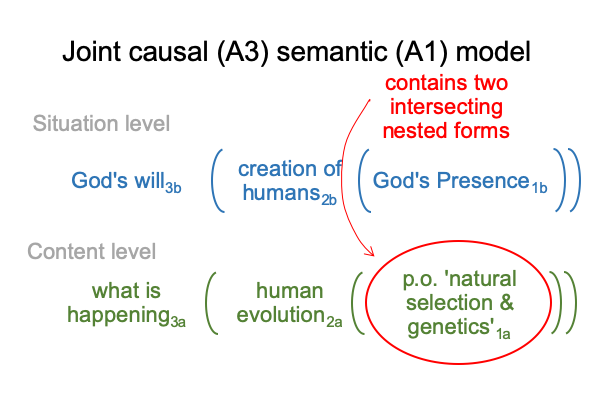
I only need to substitute God’s Will3b for the situation-level actuality3b and God’s Presence1b for the situation-level potential1b.
Here is how that looks.
Figure 4
0016 God’s Will3b associates to God’s work3b and what this means to me3b.
God’s Will3b provides subtle guidance to science work3a and what is happening3a.
Subtle guidance underlies the Anthropic Principle.
God’s Presence1b associates to the potential of humans (including me) being created in the image of God1b.
0017 How does God’s Presence1b manifest?
God’s Presence1b is the potential underlying God’s will3b. Also, it1b stands in the slot 1b, which is the potential1b of situating the content level actuality2a. This associates God’s Presence1b with the potential of situating human evolution2a.
This potential to situate operates according to joint causes, in the realm of possibility1.
God’s Presence1b virtually situates (and is emergent to) the potential of ‘natural selection and genetics’1b. The word, “virtual”, means “in virtue” (rather than the modern use, “in simulation”). The term, “in virtue”, goes with final attributes and formal design.
So, while the stuff of Neodarwinism may be scientifically regarded according to material and instrumental causes, the virtue of God’s Presence1b cannot be fully ignored in either the adaptation1a or the phenotype1a. This is the central point of the joint causal (A3) answer. Biologists cannot avoid joint causality when they discuss adaptation or phenotype. Many modern biologists label God’s Presence1b, “chance1b” or “random1b”.
0018 In sum, divine subtle intervention operates in the realms of normal context3 and potential1, as pictured above. Neither of these can be scientifically observed or measured.
0019 The pertinence of the joint causal (A3) semantic (A1) approach does not stop there.
Adaptations1a and phenotypes1a are actualities that have the potential1a of underlying human evolution2a.
That means that adaptations2 and phenotypes2 are actualities with their own nested forms.
One can imagine that God directly intervenes in either nested form by manipulating its underlying potential. Such intervention avoids detection because the actualities, adaptation2 and phenotype2 refer to the same biological entity2. In other words, two actualities2 constitute a single entity2. Therefore, the two actualities2 are confounded.
0020 Let me develop this scenario in a little more detail.
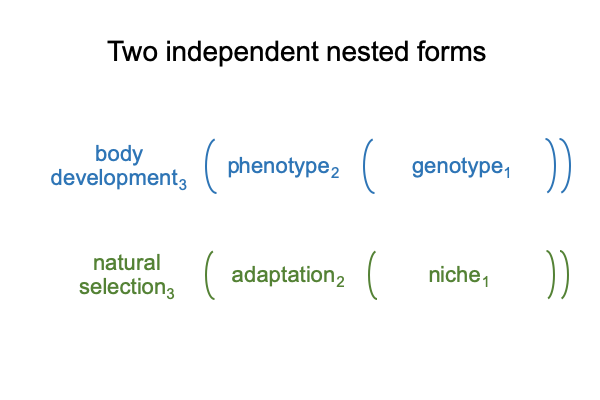
Neodarwinism1a consists in two independent nested forms, as noted in Comments on Dennis Venema and Scot McKnight’s Book (2017) Adam and the Genome. These nested forms belong to the situation-level of a two-level interscope.
In one, natural selection3b brings adaptation2b into relation with a niche1b. The niche1b is the potential1b of situating an actuality independent of the adapting species2a.
In the other, body development3b brings phenotype2b into relation with genotype1b. The genotype1b is the potential1b of situating DNA2a.
In the joint causal answer, God could directly manipulate either an actuality independent of the adapting species2a, the foundation of the niche1b, or DNA2a, the foundation of the genotype1b, without detection. Why? A change in one can mask a change in the other. They are confounders.
0021 Here is a picture of these independent category-based nested forms.
Figure 5
0022 The adaptation2 is not the same as the phenotype2. Each arises from a different potential1. Each requires its own normal context3. However, adaptation2 and phenotype2 pertain to a single actuality2, the biological entity, in this case, the human being2. The human being is the intersection of adaptation2 and phenotype2.
According to the chapter on presence in How to Define the Word “Religion”, intersections are mysterious. They contain contrasting features that cannot be resolved through the logic of noncontradiction. Biologists present distorted views when they claim that evolution consists in either natural selection or DNA-based body development. The intersection of these two nested forms codifies what biologists are really trying to say, but fail, because of preferences for either natural history or genetics.
0023 So, the joint causal answer suggests that, even if God directly manipulates the actualities underlying the niche1b or the genotype1b, scientists could never detect the intervention, because the evolved biological entity2 is an intersection, filled with contradictions.
Here is how that looks.
Figure 6
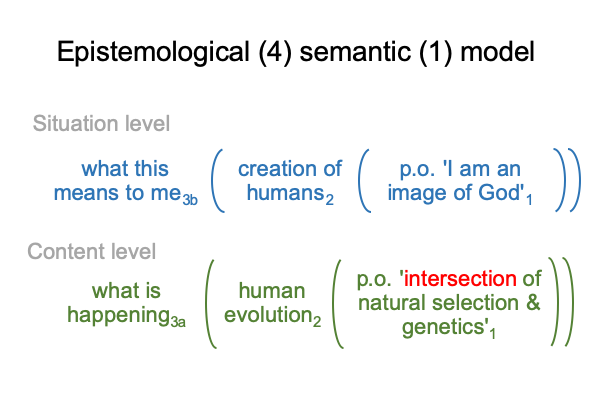
0024 This brings me to Stump’s favorite strategy (A4), the epistemological.
The epistemological strategy highlights the contrast between science work3a and God’s work3b, while simultaneously asserting that they cannot be divorced. I am a product of human evolution2a. I am created in the image of God2b. Science work3a is what is happening3a. God’s work3b is what this means to me3b.
Here is a picture of that strategy.
Figure 7
0025 Now, I address the elephant in Stump’s room.
I do so in a roundabout way.
I start with a question about the question.
0026 Does God guide human evolution?
What is the difference between this question and…
Did God guide human evolution?
0026 One strategy to answer this question is semantic (A1).
Human evolution is in our past. Are we no longer are evolving? It sure seems that we aren’t. In fact, who knows what we are doing?
0027 What does this imply?
The nomological strategy (A2) comes to bat.
Homo sapiens comes into existence, and lives for some time, in the Lebenswelt that we evolved in.
Currently, we are no longer in the Lebenswelt that we evolved in.
Therefore, our current Lebenswelt is not the Lebenswelt that we evolved in.
I conclude that a transition from one Lebenswelt to the other is missing in current accounts of human evolution.
This missing element is hypothesized in The First Singularity and Its Fairy Tale Trace and reflected upon in Comments on Original Sin and Original Death: Romans 5:12-19. This transition is dramatized in An Archaeology of the Fall, available on www.smashwords.com.
0028 With this said, the joint causal strategy (A3) cannot be ignored.
If (as proposed in The Human Niche), humans adapt into the niche of immaterial triadic relations (such as the category-based nested form), then God’s work3b virtually situates nature’s operations, as understood by science3a. In our evolution, the material world enters into an evolving awareness of immaterial triadic relations, without compromising its instrumental and material causalities.
0029 On top of that, the epistemological strategy (A4) says that God’s work3b and science work3a cannot be divorced, in the same way that what this means to me3b cannot be divorced from what is happening3a.
0030 So obviously, the elephant in the room is concordism.
Did God guide human evolution? How does God guide us today?
These questions aim to harmonize scientific formulations and Biblical revelation.
Stump is on target. Four different strategies apply. But, the target is so much larger than he realizes.
For example, Comments on Christy Hemphill’s Essay (2019) “All in a Week’s Work” introduces a harmony between cognitive psychology and metaphors within Genesis 1.
The concord between humans created in the image of God2b and human evolution2a will prove to be multi-faceted, addressing who we are2b as well as who we evolved to be2a.
0031 My thanks to J.B. Stump for publishing his evocative article.
It is official. The federal government has established a religion. May I propose a label for this new referent? Let me call it the “deep state”.
Others call it the “administrative state”.
The imprimatur comes when Steve Deace, broadcasting on Blaze TV from the heart of America’s flyover country, states the obvious, saying, “We are not dealing with a political party. We are dealing with a cult.”
For example, only a cult can perform the purgation and humiliation rites afforded to Brett Kavanaugh, then a nominee for the Supreme Court of the United States. Now a member of the SCOTUS, this individual is forever branded by one accusation. The accusation, while never proven true, is justified by its reliance on an organizational objective, claiming, “Believe the woman, for … (whatever righteousness applies)”.
Righteousness1aC is the nectar of religion.
Organizational objectives2aC are like gods.
Hey, what are those subscripts?
Subscripts are introduced in A Primer on the Category-Based Nested Form and A Primer on Sensible and Social Construction. The “1” indicates Peirce’s category of firstness, the realm of possibility. The “2” denotes actuality in a category-based nested form. The “a” refers to the content-level of an interscope (a category-based nested form composed of category-based nested forms). The “C” points to the society tier (the third tier in a category-based nested form composed of interscopes).
The three tiers are societyC, organizationB and individual in communityA.
Yes, this notation introduces a novel approach to Sociology.
Plus, this approach is worth looking into. Homeschoolers should consider the course titled, How to Define the Word “Religion”.
Why?
State indoctrinators define the word so narrowly that it seems that they are covering up a topic much larger, and more interesting, than churches, synagogues and mosques.
This brings me back to the prescience of the broadcaster noted above.
The immediate stimulus for the broadcaster’s response is a coronavirus-related national work-stoppage. The statistics associated with the unfolding pandemic simply do not support the drastic, uni-dimensional, solution of a total shutdown, bringing the US economy to a standstill.
Yes, in economics and politics, there are two dimensions. There are trade-offs.
Yet, in the matrix of the administrative state, there are only organizational objectives2aC. The Center for Disease Control (CDC) and other state-cults3aC focus on saving lives2aC. We must save lives at all costs1aC.
Organizational objectives2aC emerge from (and situate) the potential of righteousness1aC.
The problem?
They2aC may come into conflict.
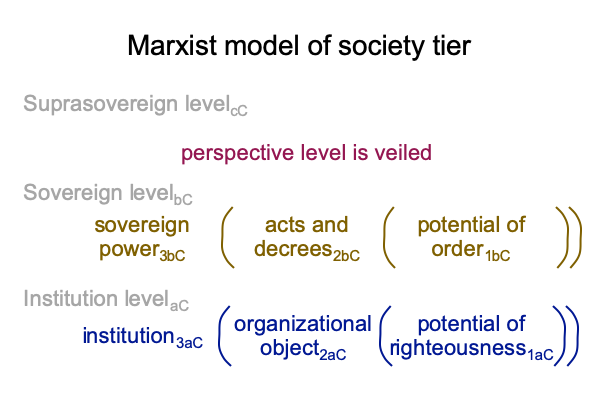
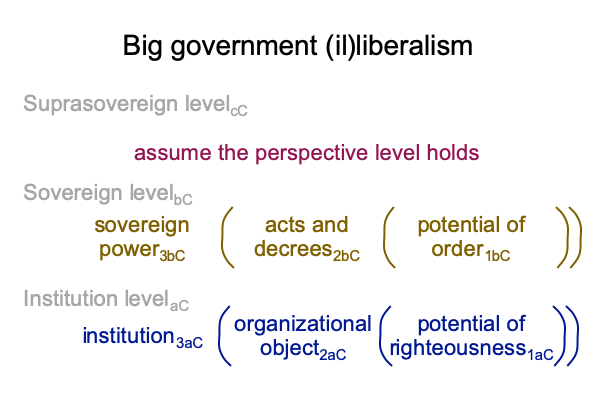
One solution endows each insitution3aC with a similar character. In the case of the deep state, that character is a demand for sovereign power3bC. Sovereign laws and decrees2bC are necessary in order for each institution3aC to achieve its organizational objectives2aC. This imperative1cC satisfies the potential underlying all legislation2bC: the possibilities inherent in order1bC.
Picture piglets struggling to latch onto their mother’s teats. Each has its own agenda. Of course, these agendas conflict. Yet, a certain order is achieved as long as the mother offers her milk.
Or consider the abandoned infants, Romulus and Remus, suckling the teats of a she-wolf. Surely, the Romans offer a more evocative icon of the feminine nature of sovereign power. Believe the she-wolf and she will offer her milk, instead of her teeth.
To Marxists, there is nothing more. The sovereign3bC must be the exception1cC. The state3bC must not be subject to its own laws2bC. The milk2cC must flow1cC. The milk2cC sustains order1cC. Order1bC is to sovereign power3bC as righteousness3aC is to institutions1aC. Listen to the speakers. Hear the talking heads. Every shill3aC signals a virtue1aCthat calls the citizen to a righteousness1aC that seeks to establish order1bC.
There is nothing above sovereign power3bC.
Yet, there3cC is.
The problem is that we cannot envision it2cC.
Here is a way to picture the society tier for Big Government (il)liberalism.
The two-level interscope is typical for sensible construction. Sensible construction does not ask, “Why?”. Sensible construction assumes that, whatever we are doing, it’s okay. The perspective level is never questioned, unless something goes horribly wrong.
Here is a picture of the society tier for Big Government (il)liberalism.
Figure 2
If there is anything hidden within the perspective level, it is this: The milk2bC must flow1cC.
That is, the milk of the federal government2bC.
There are no suggestions for why the milk must flow, except for the fact that so many institutions3aC demand sovereign power3bC in order to implement2bC their organizational objectives2aC. Institutions3aC that do not appeal to Caesar3bCoften wither or mutate into institutions that do. Mutation is facilitated through infiltration by believers2cA in a particular (sovereign-entangling) righteousness1aC.
Each organizational objective2aC is a god.
Some call them “sacred cows”.
Since each organizational objective2aC emerges from (and situates) the potential of righteousness1aC and since righteousness1aC is inherently metaphysical in nature, the deep state consists in a wide range of cults (institutions3aC) that have a common feature. Each righteousness1aC accommodates a call for sovereign power3bC.
Diversity is the strength of Big Government (il)liberalism.
However, there is a problem.
All the advocates claim to be “not religious”, even though they are.
Why?
Why do the advocates for Big Government (il)liberalism, who congregate in cults3aC, claim to be “not religious”?
Well, the American Constitution’s first amendment states that the federal government shall not establish a religion.
Consequently, acolytes of the deep state define “religion” narrowly, with intellectual constriction, as falling into bins labeled “Christian”, “Jewish”, “Islamic” and so forth. In this way, they skirt the question that cannot be confronted. Why is their righteousness not “religious” as well? These state-entangled institutions3aC implement organizational objectives2aC that situate the potential of righteousness1aC. Why is their metaphysical righteousness exempt? Why are not they “religious”?
This crucial point is ignored by current experts in Sociology, because they are committed to Big Government (il)liberalism. Okay, that’s a cheap shot. But really, the answer demands a definition of the word, “religion”, that does not simply slap labels onto people. Do any sociological theories explain why the labels work? Or, do the labels explain themselves?
The course, How to Define the Word “Religion” offers a novel definition, one that is not hemmed in by a deep-state historical narratives or restrictive legalisms.
But wait, the indoctrinated… er, educated citizen replies, “Okay, let’s be sensible. These state-entangled institutions, and their advocates, say that they are not religious because they are not ‘Christian’, ‘Jewish’, ‘Islamic’ and so forth. This is obvious. Everyone agrees.”
Shall I venture a translation?
If you disagree, no milk for you. Instead, you will feel the sovereign’s teeth.
This is a word-game, where so-called “enlightenment” institutions3aC advocate for certain laws and decrees2bC in order to promulgate their organizational objectives2aC, yet declare themselves to be “not religious”. Why is their righteousness1aC different from the righteousness1aC of institutions that fall under the label? How do their missions2aC differ from the Christian, Jewish and Muslim missions2aC? Why do they say that they are not religious?
Oh, yes, that gets around the first amendment.
Clearly, the veiled perspective levelc of the deep state encourages subsidies2bC for innumerable “points of light”, institutions3aC that self-identify as “not religious”, yet are founded on diverse calls to righteousness1aC. These cults3aC that have a character in common. Each point of light3aC signals its virtue1aC, while demanding that state laws and decrees3bC implement its organizational objectives2aC.
The advocate-lobbyist says, “Our missions2aC are ‘not religious’, yet are necessary for the organization of a righteous society.”
The advocate-lobbyist cannot say, “There may be a reason why the organizational objectives2aC of all deep-state institutions3aC call for the exercise of sovereign power3aC. But, we cannot know the reason until the milk becomes all there is.”
Only then, will the veil be pulled back and the perspective levelc revealed.
What do we know?
Big Government (il)liberalism establishes institutions3aC that declare themselves to be “not religious”, even though, like Christian, Jewish and Islamic institutions3aC, they contextualize organizational objectives2aC that emerge from (and situate) the potential of righteousness1aC. Their declaration exempts them from the first amendment of the American Constitution.
Big Government (il)liberal organizational objectives2aC have a common feature. Their2aC implementation relies on sovereign power3bC. Since sovereign power3bC is not subject to its own laws and decrees2bC, then the resulting institutions3aC participate in the sovereign’s state of exception. In fact, the sovereign3bC is the only one who can bring contemporary trends to fulfillment by cultivating a state of exception2cC.
The federal government not only has established a host of religions3aC, each standing as a point of light in a New World Order, but all these religions3aC vicariously participate in the exception2cC that contextualizes sovereign power3aC.
What does this imply?
The theology of the deep statec is yet to enter into consciousness in our current, Enlightenment-celebrating, Zeitgeist. State-entangled institutions3aC are everywhere. Few have eyes to see. Many avert their gazes. The suprasovereign levelcC stands behind a curtain and will step out only when a state of exception2cC brings all into relation1cC. That moment will be a revelation.
There are signs of a future unveiling. The hour draws near.
Consider Comments on Peter Burfiend’s Book (2014) Gnostic America.
Consider Comments on Eric Santner’s Book (2016) The Weight of All Flesh.
These works belong to the Intimations of Political Philosophy series, available at smashwords.
Broadcaster Steve Deace reads the writing on the wall, announcing, “We are not dealing with a political party. We are dealing with a cult.”
The federal government has established a legion of religions3aC, each declaring itself to be “not religious”. Plus, each has one other feature in common with all others. Where are the intellectual tools to articulate these sociological phenomena?