Man and Sin by Piet Schoonenberg (1964) 2.3 BAI
Summary of text [comment] page 88
[Where does reason come in?
Reason may alter I, seat of choice3V, in relation to the possibilities underlying my choice1V.]
What about this vision of Original Sin as a reification of our own interpretations of the ‘what is real’. Once reified, a “serpent” inspires us to actions that produce results that differ from expectations (i.e. what is defined to be ‘real’). How do we deal with those results? Examples? And how does this picture resonate with traditional interpretations of these chapters of Genesis. This topic is addressed in chapters 11,12 and 13.
Summary of text [comment] page 88
[The co-opposition of thoughts3V(2 and deeds2(1V) is not isolated from responsibility3H(2 and freeedom2(1H).
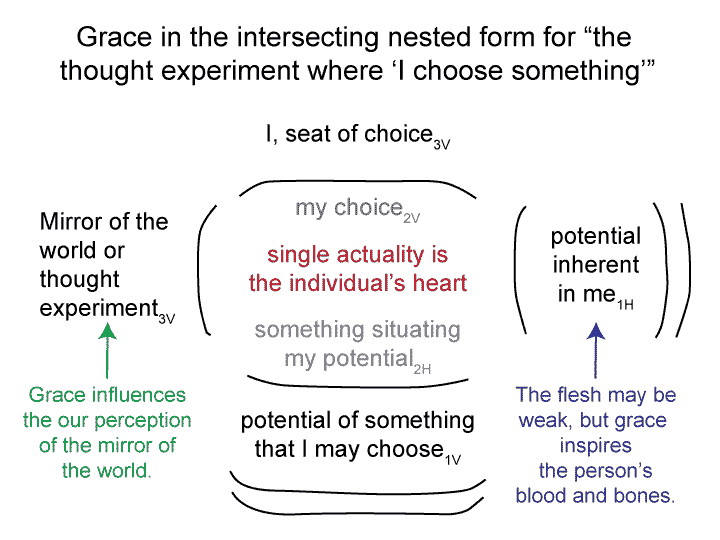
Grace enters through ‘the mirror of the world3H’ or through ‘the intuitions of my blood and bones1H’. It produces new contradictions that alter the entire intersection.]
[This resonates with ‘I, seat of sight3V’ discerning new ‘possibilities inherent in the something that scatters light1V’.
The horizontal relation alters the single actuality shared with the vertical relation.]
Summary of text [comment] page 88
[The vertical axis is not unaffected.
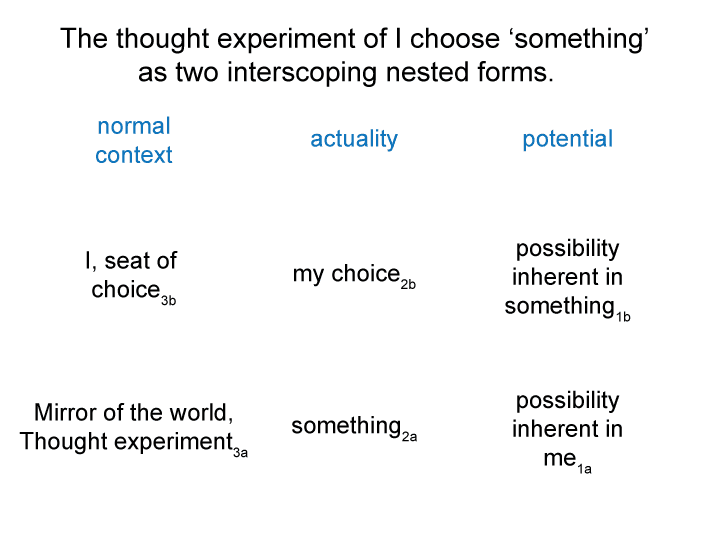
The vertical axis intersects with the horizontal in the single actuality containing ‘my choice2V and something2H’.
The single actuality of ‘my heart2’ parallels ‘what I see2’.
‘I, seat of choice3V’, encounters new ‘possibilities inherent in something that I may choose1V’.]
Summary of text [comment] page 88
[Or maybe, grace can directly influence the potential inherent in me.
The original Old Testament notion of the ‘flesh’ as opposed to the ‘blood and bones’ reminds me of this. The flesh may yearn for what is reflected in the mirror of the world. That yearning yields bondage.
But the blood and bones yearn for God. Their yearning is for freedom. They yearn for the warmth of the divine light. They yearn to stand before the Lord.]
[Is grace to be found in the mirror of the world3H?
Grace increases the capacity of responsibility3H(2H and, through the co-opposition, the opportunities for freedom2H(1H).
Grace decreases the incapacities generated by words3H(2H and, through the co-opposition, the burdens of bondage2H(1H).]