11/15/22

Looking at Daryl Domning’s Book (2006) “Original Selfishness” (Part 6 of 16)

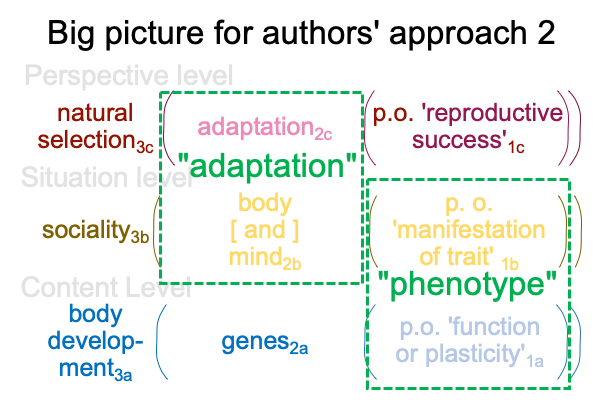
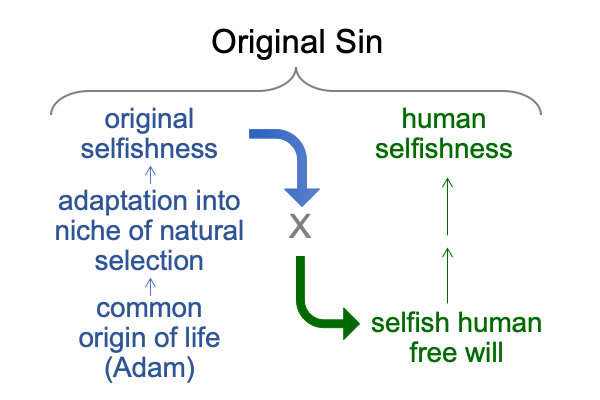
0037 In prior blogs, I associate a sequence of four waystations in the history of the word, “selfishness”, to four elements in Domning’s visualization of original sin.

0038 Traditional theological accounts of original sin fuse its universal and its moral realities.  

The universal reality is direct descent from Adam and Eve, as proposed by Saint Augustine seventeen centuries ago.  This universal reality has been debunked by modern genetics.

The moral reality is a corruption of human free will.  People tend to be selfish, even with moral deliberation.  This implies a fall from full rationality and self-control.

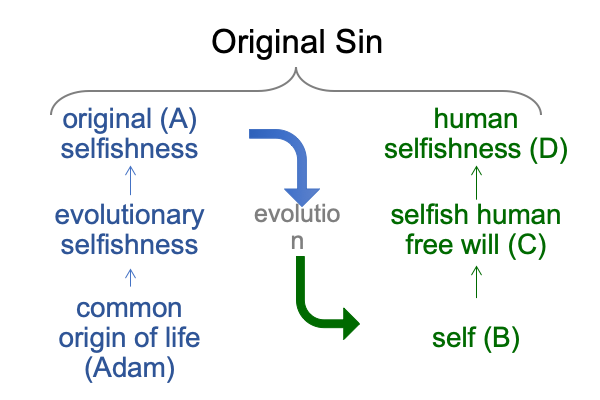
0039 Domning’s theological account separates original sin’s universal and moral realities.  But, the separation is not complete, because original selfishness (A) evolves into the self (B).

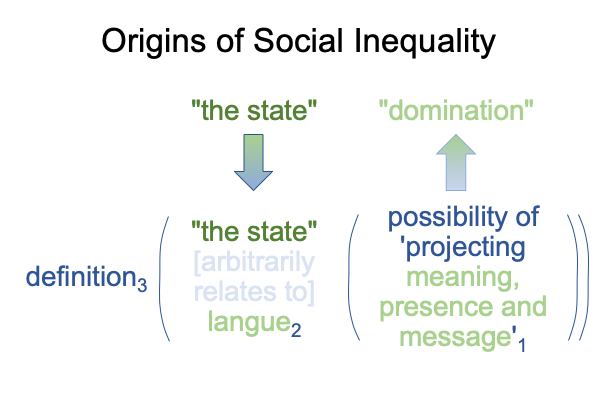
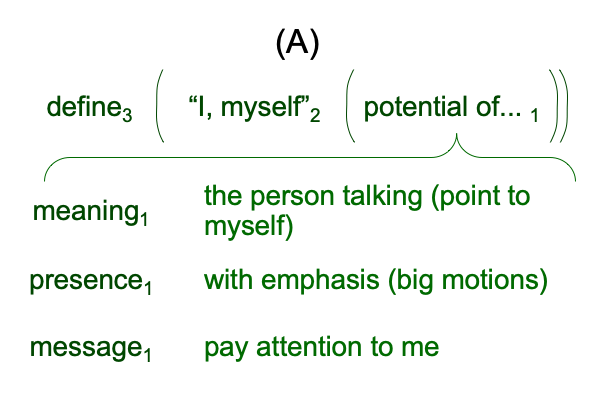
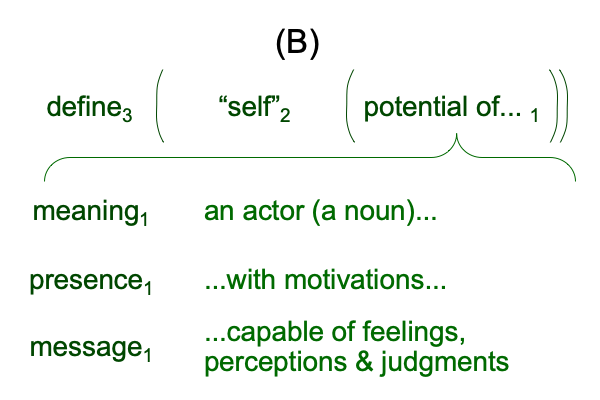
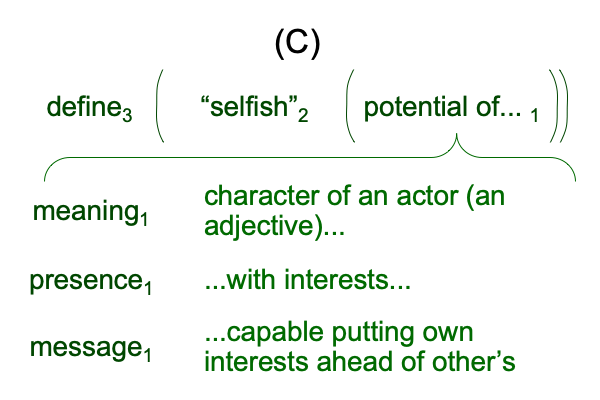
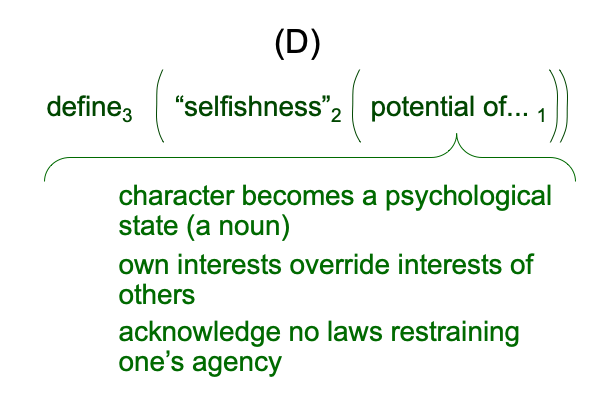
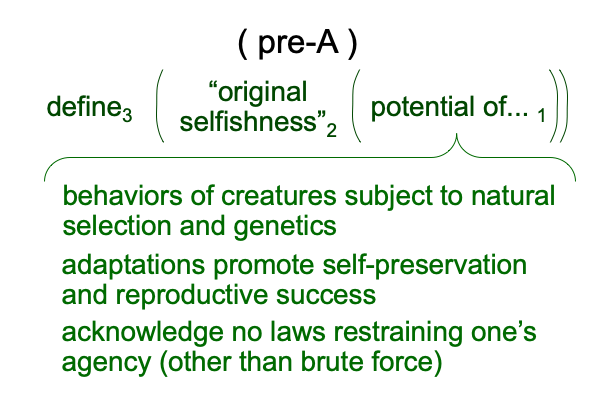
Evolutionary selfishness (pre-A) culminates in psychological expressions of I-myself (original selfishness, A), which I associate to the initial terminus of the term, “human selfishness” (D).  The passage involves the terms, “self” (B) and “selfish” (C).  Moral deliberation enters the picture with the term, “selfish”.

The moral reality, the disordered practices of human selfishness, is nothing more than original selfishness, but now with moral deliberation.

0040 The association between four waystations in the history of the word, “selfishness”, with four elements in Domning’s visualization of Original Sin appears convincing.

So, I want try my luck with another composite term, “concupiscence”.

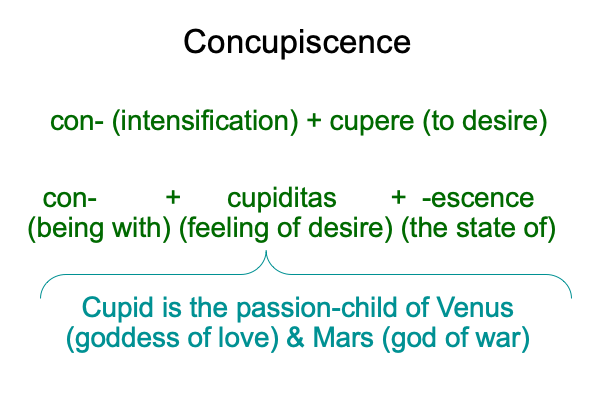
“Concupiscence” builds upon three technical expressions.  These technical expressions associate to waystations (B, C and D) in this development of the word, “selfishness”.

Figure 11

Note that these technical definitions do not correspond to traditional definitions of these words.  I will get to that difficulty later.

0041 Once again, where am I going with this?

0042 The development of the word, “selfishness”, parallels Domning’s argument about the nature of original sin, once its universal and moral realities are separated.

The key step is the transition from the emphatic, I myself (A), to self (B), a noun.  Domning attributes this step to evolution.  The next step is the adjective, “selfish” (C), describing a tendency towards placing one’s own self above others.  Here, moral constraints may come into play.  “Selfishness” (D) reifies the adjective.

0043 Now, I want to repeat the procedure with the word, “concupiscence”.  Concupiscence is traditionally used to describe the moral reality of original sin.  The universal reality is descent from Adam, which now has been debunked by science.

11/14/22

Looking at Daryl Domning’s Book (2006) “Original Selfishness” (Part 7 of 16)

0044 The development of the word, “concupiscence” (D’), from the originating emphatic, I-myself (A), produces technical definitions of words, that are at odds with traditional definitions.  Cupid (B’) starts by labeling the presence of self among other selves.

Figure 12

Cupid (B’) associates to self (B).  If self (B) labels the intensional awareness of an internal consolidation of various, situational I-myselves, then cupid (B’) labels an extension of that awareness.  This extension occurs, in the Lebenswelt that we evolved in, as individuals cooperate in social circles, the family (5), intimates (5), teams (15), bands (50), communities (150) and so on.  So, the consolidation that produces the self (B’) is motivated by a competition to perform as a self among other selves in various social circles.

That competition entails concupiditas (C’), the desire to perform as a self among other selves.  Concupiditas (C’) corresponds to selfish (C).  Concupiditas (C’) is an adaptation that satisfies the biological criteria of evolutionary selfishness and conforms to Domning’s criteria for original selfishness, manifested in the emphatic, I-myself (A).

0045 Here is a picture.

Figure 13

0046 Like cupid (B’), the technical term, concupiditas (C’), does not align with common parlance.

A contemporary example of a concupidic behavior (C’) takes place in bars and houses around college campuses.  Drinking games meld competition and cooperation.  Each participant is a cupid (B’), competing to shoot an arrow into a keg of beer, in order to endear oneself to others in the drinking group.

One must compete in order to cooperate?

How twisted is that?

0047 Concupiditas (C’) is situational.  Concupiditas entails human choice.  Concupiditas introduces rules to the game.  Concupiditas is being with others, in particular situations, where performance is congruent with belonging.

The rule of the drinking game is simple.  Drink as much beer as you can.  This rule is given precedence over other rules, such as long-term cooperation necessitates that other selves are not injured.  The drinking game entails risk.  Concupiditas (C’) entails a human choice about which game to play.  The games belong to concupiscence (D’).  The choice belongs to the person and concupiditas (C’).

0048 Concupiscence (D’) corresponds to selfishness (D).  One must compete to cooperate.  One must perform in every social circle that one belongs to.  That performance entails risk.  Sometimes one is born into a social circle (the family, band and community).  Sometimes one must choose (intimates, team).  Concupiscence (D’) is the state of competing to cooperate.  Each self desires to cooperate, because those who cooperate take the greater risks and enjoy the greater benefits.  Each self desires to be among other selves.  Each self has its own original selfishness.  Every game and every social circle has rules, established by tradition.

Figure 14

We compete to belong to and to flourish within social circles.  We compete to cooperate. 

11/4/22

Looking at Daryl Domning’s Book (2006) “Original Selfishness” (Part 13 of 16)

0079 Domning is on target, even while completely missing his intended endpoint.  Evolution is red in tooth and claw.  Evolution is also the most economic means to an end, the glory of God, in the abundance and diversity of life on Earth.  One cannot pick and choose.  God creates the world.  God calls it “good”.

But, one can misread the creativity of natural selection, by insisting that all niches are potentials of material things.  There is one niche that is the potential of an immaterial thing, the triadic relation.  That is the human niche.

When I consider this unique niche, then the evolution of concupiscence (D’) produces a definition that inverts the traditional theological term.

0080 There is a reason for this inversion of meaning.

These alternative definitions apply to the Lebenswelt that we evolved in.

Here is a list.

Figure 20

0081 What does this imply?

The traditional definitions apply to our current Lebenswelt.

Here is a list.

Figure 21

0082 The alternate definitions describe original justice.

The traditional definitions describe original sin.

0083 What else does this imply?

Our current Lebenswelt is not the same as the Lebenswelt that we evolved in.

11/1/22

Looking at Daryl Domning’s Book (2006) “Original Selfishness” (Part 16 of 16)

0097 Original sin is the absence of original justice.

That is what Saint Thomas Aquinas claims.

The association between original justice, the state of Adam before the Fall, and the Lebenswelt that we evolved in is developed in Comments on Daniel Houck’s Book (2020) “Aquinas, Original Sin and the Challenge of Evolution”.

0098 This examination of Daryl Domning’s book adds depth to that commentary.

By separating the universal (descent from common ancestor) and moral (the traditional definition of concupiscence) realities of original sin, Domning offers me a path to discover one of features of the Lebenswelt that we evolved in, as well as one of the features of our current Lebenswelt.

0099 What games we play with words.

My thanks to Daryl Domning and Monica Hellwig for their speculative effort, trying to reconcile evolutionary science and Christian doctrine.  Original Selfishness: Original Sin and Evil in Light of Evolution is first published in 2006 by Ashgate.  My copy is published in 2016 by Routledge.  The first edition in paperback is issued in 2021.  ISBN is 978-1-03-224358-0.

10/31/22

Looking at Loren Haarsma’s Book (2021) “When Did Sin Begin” (Part 1 of 21)

0001 Loren Haarsma is an old man, a physics professor and a Christian.  As a fellow of the American Science Affiliation, he has lectured on the intersection of science and faith.  He is a scholarly voice in the Biologos network.

The full title of his book is When Did Sin Begin: Human Evolution and The Doctrine of Original Sin (2021, Baker Academic, Grand Rapids, MI).

If one goes to the resources page for the Biologos.org website, then selects the topic, “Bible”, and the subtopic, “Adam and Eve”, one will find an extensive collection of essays on the concerns in Haarsma’s title: timing, evolution and original sin.

0002 How do these concerns fit into a category-based nested form?

Timing calls forth a normal context3.  The question, “when?”, implies an event.  Here, the event is a transition.  For evolution, the transition is a topic of natural inquiry.  For original sin, the transition is a topic for theologians.

Human evolution and original sin belong to the realm of actuality2.

The only item not mentioned is potential1.  Here, the question mark applies.  For human evolution2, the potential must be adaptive change1.  For original sin2, the potential is the start of sin in our current Lebenswelt1.

0003 To me, these concerns yield two category-based nested forms.

Here is a picture, following the recipe in A Primer on the Category-Based Nested Form.

Figure 01

0004 These two normal contexts exclude one another.

0005 The upper normal context3 associates to evolutionary science.  The focus of attention is on natural history and genetics.

Typically, an adaptive change produces speciation.  However, in human evolution, an adaptive change may be cultural.  Human evolution is both biological and cultural.  Since natural history and genetics do not adequately describe culture, they may not be enough to scientifically describe human evolution.  Indeed, no natural science convincingly addresses cultural change.

0006 The lower normal context3 associates to theological science.  The focus of attention is on special and general revelation.

Special revelation includes Genesis 1-11.  Genesis 1-11 divides into two parts.  In the Primeval History (chapter 2:4-11), Adam is brought to life as the first human, even though um… in the Creation Story (chapter 1-2.3), humans are already intended, created and blessed, in the framework of six days of creation.

General revelation includes Greek philosophy, among other traditions.  Greek philosophy is useful for resolving contradictions.  For example, some theologians resolve the contradiction inherent in the two parts of Genesis 1-11 by claiming that Adam (in Genesis 2.4-4) is the male and female “them” that God intended, created and blessed (in Genesis 1).

Say what?

In the Creation Story, God creates them, male and female.  So, Adam must have had some sort of divided consciousness, one operating in his mind and the other working in his ribs.

Just kidding.

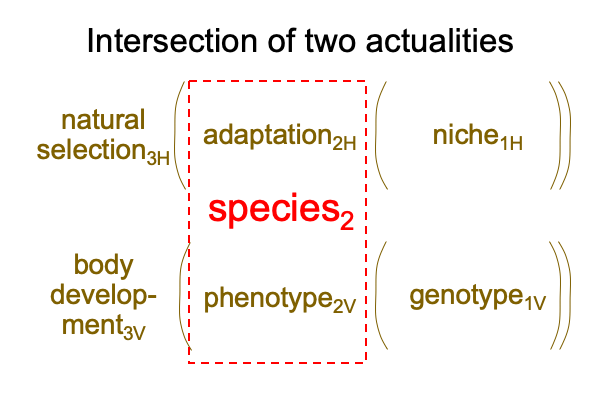
0007 Greek philosophy’s usefulness is not limited to resolving contradictions, no matter how silly the resolution may be.  Greek philosophy may also be used in situations where contradictions cannot be resolved.  Such a situation occurs here. Human evolution2 and original sin2 belong to a single actuality.  They both pertain to one realness2.

Here is a picture.

Figure 02

0008 Two (apparently independent) category-based nested forms intersect in the realm of actuality2.  The two constituting actualities cannot escape the one realness, because they constitute the one realness.  Certain contradictions are accidental. Certain contradictions are essential.  Greek philosophy is useful for separating the accidental from the essential.  A set of essential contradictions is called “a mystery”.

10/25/22

Looking at Loren Haarsma’s Book (2021) “When Did Sin Begin” (Part 5 of 21)

0038 I summarize.

Chapter four covers human evolution.

Haarsma engages in a discussion of human evolution2H as if it does not intersect with original sin2V. Yet it does, otherwise Haarsma would not write a book about it.

Haarsma’s titular question2V, “When did sin begin?”, should place the hypothesis of the first singularity2H side by side with the doctrine of original sin2V.

But, since Haarsma is not aware of the hypothesis of the first singularity, the term, “human evolution”, goes into the slot for actuality2H for the normal context of natural change3H.

This does not work, of course, and leads to a winding path, back to the crucial intersection between the first singularity2Vand original sin2H.

0039 The path starts by asking, “What contributing actuality2V, in a theological framework3V, corresponds to human evolution, as Haarsma discusses the topic?”

The answer comes from Thomas Aquinas’s suggestion that original sin is the lack of original justice.  Original justice is entangled with human evolution.

Figure 11

0040 If human evolution2H is one of the actualities in an intersection, the corresponding actuality is not original sin2H.  The corresponding actuality is really the stuff of the Creation Story2V.

The structure of Haarsma’s text validates this suggestion.

Chapter four, titled, “Human Evolution”, is preceded by chapter three, “Suffering and Death Before Humans”, and followed by chapter five, “The Soul, the Imago Dei and Special Divine Action”.   Chapters three and five point to Genesis 1:26-31.

10/18/22

Looking at Loren Haarsma’s Book (2021) “When Did Sin Begin” (Part 10 of 21)

0070 Chapter six is titled, “Adam and Eve in Scripture”.

Haarsma asks (more or less), “What is the best way to understand the Adam and Eve story in Genesis 2-3?”

0071 Surely, this is a question that humans evolve to ask.  Humans want to understand.

We encounter an actuality.  We then ask, “What normal context3 and potential1 applies to this actuality2?”

This is the start of understanding.  We understand when we construct a category-based nested form.

0072 Here is a picture.

Figure 19

0073 The best way to understand the Adam and Eve story2 is to locate the most productive normal context3 and potential1.

0074 Haarsma begins with the normal context3 of historical scholarship of the Bible3.

The corresponding ‘something’ resolves into implications of the words in the text1.

For example, John Walton concludes that the names, Adam and Eve, are assigned names, not historical names.  An assigned name is a name that is assigned by the storyteller.  A historical name may be replaced by an assigned one.

Plus, the word, “Adam”, denotes “a man of the earth” as well as a person.

0075 Advocates for historical scholarship argue that Genesis 2:4-11 (unlike other origin stories of the ancient Near East) offers an unparalleled narrative theology.  The issue is not whether Adam and Eve exist as historical persons.  The issue is the clarity of theological meaning.

0076 The problem?

What about human evolution?

Well, if theologians appreciate the stories of Adam and Eve because of their theological clarity, in contrast to the other mythologies of the ancient Near East, then original sin must be a clear insight that situates the stories of Adam and Eve.

0077 This relationship may be diagrammed as a two-level interscope.

Figure 20

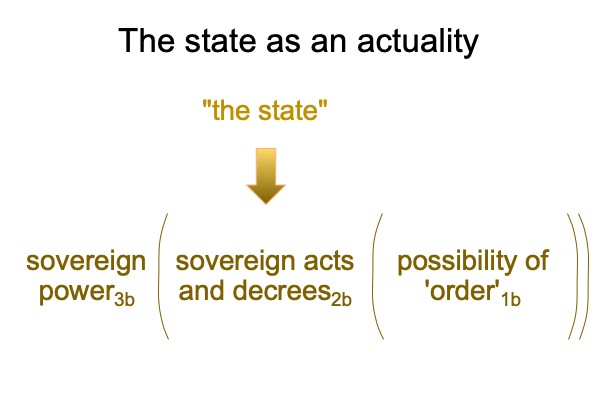
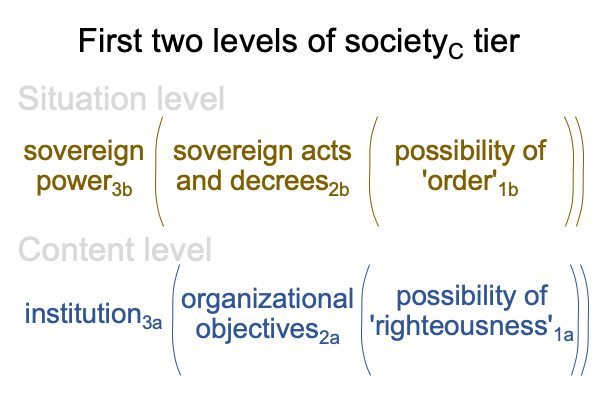
The doctrine of original sin2b situates the potential of the stories of Adam and Eve1b in the normal context of a theological transition to our current Lebenswelt3b.

The situation level clarifies the content level.

The stories of Adam and Eve2a situate the potential of origin myths, as investigated by historical scholarship1a, in the normal context of the ancient Near East3a.

0078 The situation-level is also the nested form that goes into the intersection of our current Lebenswelt.  It constitutes the vertical axis.

0079 It makes me wonder, since the underlying content of original sin2V touches base with the ancient Near East, does the twist in human evolution2H potentiate the formation of civilization in southern Mesopotamia?

Consider Comments on Dennis Venema and Scot McKnight’s Book (2017) Adam and the Genome, available at smashwords and other e-book venues.

10/7/22

Looking at Loren Haarsma’s Book (2021) “When Did Sin Begin” (Part 17 of 21)

0112 Two nested forms intersect for our current Lebenswelt.

A theological transition3V brings the doctrine of original sin2V into relation with the noumenal potential of Genesis 2:4-111V.

A natural transition3H brings a twist in human evolution2H into relation with the phenomenal potential of an adaptive cultural change1H.

0113 The twist in human evolution2H is described in the hypothesis of the first singularity.

Here is a synopsis.

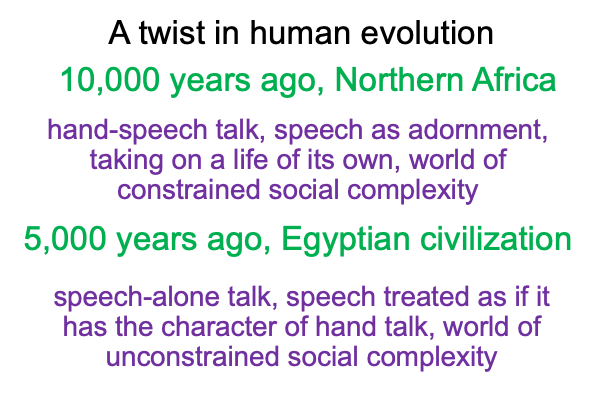
Language evolves in the milieu of hand talk.  Speech talk is added to hand talk with the appearance of anatomically modern humans (over 200,000 years ago).  Hand-speech talk is practiced through the Paleolithic and into the Neolithic.  The semiotic qualities of hand-speech talk favor constrained social complexity.

The first culture to practice speech-alone talk is the Ubaid of southern Mesopotamia (starting around 7,800 years ago).  At the time, all other Neolithic, Mesolithic and Epipaleolithic cultures practice hand-speech talk.  Because the semiotic qualities of speech-alone talk unconstrains social complexity, labor and social specialization prospers during the Ubaid. The surrounding (hand-speech talking) cultures see it.  The Ubaid exhibits increasing wealth and power.  Plus, all the surrounding cultures need to do, in order to imitate the Ubaid, is to drop the hand-talk component of their hand-speech talk.

Speech-alone talk spreads from the Ubaid through imitation.

0114 The twist in human evolution2H permits increasing labor and social complexity1H.

But, the semiotic qualities of speech-alone talk also makes the cultural adaptations of the Lebenswelt that we evolved innonsensical.  

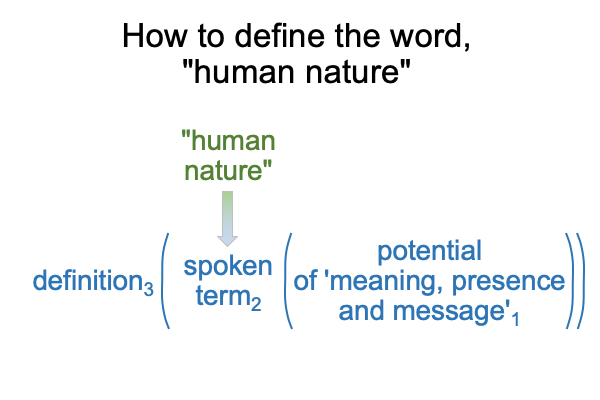
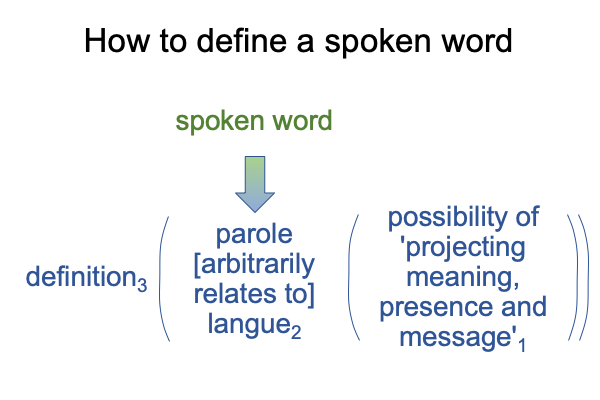
Even though we innately expect our (hand talk) words to image and point to their referents, in our current Lebenswelt, we project meaning, presence and message into our (spoken) words, then construct artifacts that validate those projections. 

How can a tradition in hand-speech talk be translated into speech-alone talk?

It cannot.

08/26/22

Looking at John Walton’s Book (2015) “The Lost World of Adam and Eve” (Part 3 of 22)

0018 What is proposition two?

In the ancient Near East and in the Old Testament, the Hebrew terms for “creating” (bara) and making (asa) applies to establishing order by assigning roles and functions.

0019 In the modern world, “creating” and “making” concern material production of things, irrespective of roles and functions.  Of course, moderns have the luxury of centuries of research into the material sciences.  Modern science follows the dictates of the Positivist’s judgment, which includes the empirio-schematic judgment.

The Positivists take the plain-speaking approach out of the reformed churches and into the natural sciences.  Mathematical and mechanical models eschew formal and final causalities (the stuff of roles and functions) and extol material and instrumental causalities (the stuff that one can explicitly abstract and specify).

0020 The empirio-schematic judgement does not apply to the old Hebrew terms.  Therefore, the Positivists declare, “Genesis is not scientific.”

Walton tries to respond, “But, that is not the point of Genesis.”

Then, the Positivists persist, “Then, are you saying that Genesis is esoteric knowledge?  If so, then plain-speaking interpretations of Genesis are not possible.”

0021 The Positivists, the heirs of the mechanical philosophers, place Walton in a difficult position.  Walton belongs to a plain-speaking tradition.  Positivists say that the only way to speak plainly, is to speak scientifically.

Walton replies, “Okay, let us look at the other appearances of the key words of Genesis 1, bara and asa, and fashion a scientific interpretation.”

0022 The results?

Bara means to create things with roles and functions.

Asa means to make things with roles and functions.

The ancients focus, not on material phenomenal reality, but on things themselves.

Here is a plain-speaking result that appeals to the science-minded.

0023 I would like to associate bara and asa to Aristotle’s hylomorphe, portrayed as an exemplar of Peirce’s category of secondness.  Like the Latin term, esse, being as existent, bara associates to being [substantiates].  Like the Latin term, essence, asa associates to [substantiating] form.

I write esse as esse_ce, the complement of essence.

In the following figure, I portray the Hebrew terms.

Figure 03

0024 In sum, key Hebrew terms in Genesis associate to later Greek philosophical insights.  Esse_ce (the fact that it exists) and essence (the fact that it has form) belong to the noumenon.  The noumenon stands outside the empirio-schematic natural sciences.  So, the noumenon is derided as “esoteric”.  Yet, the noumenon, described as a hylomorphe, is the gateway to natural philosophy.

08/25/22

Looking at John Walton’s Book (2015) “The Lost World of Adam and Eve” (Part 4 of 22)

0025 What is proposition three?

Genesis 1 concerns functional origins, not material origins.

0026 Positivists expropriate plain-speaking interpretations, the way of the Reformation.  A plain-speaking interpretation must now be a materialist one.

I reply, “Scientific accounts are based on phenomena.  Functional accounts address noumena.  The entrance point to noumena, for Greek natural philosophy, is the actuality of the hylomorphe.”

0027 Here is a picture.

Figure 04

0028 Proposition three instructs me to consider the six days of creation in terms of hylomorphes.

0029 The first three days entail separation.  Separation establishes order and function.

0030 For day one, the light and darkness (esse_ce) separate, yielding day and night (essence).

Figure 05

0031 Following the path established in A Primer on the Category-Based Nested Form, this actuality2 calls for a corresponding normal context3 and potential1.

Here is a picture.

Figure 06

0031 The triadic normal context of day one3 brings the dyadic actuality of light & dark [substantiates] day & night2 into relation with the monadic possibility of ‘something’1.

According to Walton, ‘something’1 is the role and function of time.

0032 The second day portrays a second separation.  The waters above and the waters below separate, yielding the vault of the heavens, explicitly, and the location of the witness, on the other.

Figure 07

0033 Day Two3 is the normal conext3.

‘Something’1, according to Walton, is a living space for all creatures1.

Other words for ‘something1‘ are herehome and weather.

0034 The third day presents a third separation and a first constitution.  The land separates from the seas.  The hylomorphe is redundant.  Land, sea [substantiate] land, sea.

Then, vegetative life appears.

Figure 08

0035 Day three3 is the normal context3.

‘Somelthing’1 includes all types of plants, especially familiar ones, as fondly described in detail in the Genesis text.  Plants are food.

0036 Walton concludes that days one, two and three identify major features of human experience: time, weather and food.

Days four through six describe what happens next.

0037 In day four, God places luminaries in the heavens.

Figure 09

0038 In the normal context of day four3, these celestials signs have roles and functions1 that pertain to time (the potential1for day one3).

Day five portrays animal life in the sea and expands from there.

Figure 10

0039 In the normal context of day five3, aquatic life is available for food1.  It is not life that humans can sympathize with.  Fish are very different from humans.

0040 Land animal life appears in day six.

Figure 11

Indeed, humans are created towards the end day six.

No creature is more familiar to humans than humans.

0041 Surely, the Creation Story does not detail the phenomena of creation (that is, the stuff that science is interested in).

Rather, the Creation Story portrays the noumena of creation (and that is very curious, because it reads like an evolutionary scenario).