11/28/25

Looking at Dennis Venema and Scot McKnight’s Book (2017) “Adam and the Genome” (Part 2 of 22)

0008 Adam and the Genome divides into two parts.  Each part is about 100 pages long.

0009 In the first half, Dennis Venema, a biologist versed in genetics, lays out the case for the impossibility of a bottleneck in human evolution.  Adam and Eve cannot be the first anatomically modern humans.

In the second half, Scot McKnight, an evangelical theologian familiar with ancient Near East literature, lays out the case against a historical Adam.  No early Jewish or Christian writer, including the preacher Paul, regarded Adam and Eve as the biological ancestors of all humans, the parents of the species, whose DNA is sown into all living human beings.

0010 By “early” I mean before Augustine (around 400AD).  McKnight does not elaborate how Augustine wrote the dramatic script calling for a historical Adam who is literally the father of all sinners.

Augustine’s script has been performed on stage for over one and one-half thousand years.  What a run.

0011 The current examination separates the two halves.  I consider each half in a very different manner.

0012 My metaphor goes like this:  Each half is like a curtain, lowered in order to conclude the continued enactment of Augustine’s drama.

0013 Evangelicals have seen the play a thousand times.  Eve is called “the mother of all living”.  The serpent fooled her.  Adam went along.  Then, they had children, spreading their fallen natures to us all.

No wonder Evangelicals yearn for a biological historical Adam, a literal father of all living, that will prove the so-called “rational” BG(il)L zealots wrong.  They know Augustine’s play by heart.  Why can’t the show continue?

0014 Venema and McKnight theatrically lower these two curtains, one on either side of the stage.

They declare, “The play cannot go on.  There is no biological historical Adam and Eve, from which all human DNA descends (with modification).  Plus, the Genesis stories are similar to the literature of the ancient Near East.  The Bible must be read in context.”

0015 Ah, but God’s grace is like a diva.  If she cannot be on stage, she will take to the curtains.  Read these comments and you will see.  The curtains come alive.
11/26/25

Looking at Dennis Venema and Scot McKnight’s Book (2017) “Adam and the Genome” (Part 3 of 22)

0016 Dr. Venema tells a great story.  He was raised as an evangelical, suspicious of modern evolutionary biology.  He became a geneticist.  The turning point came when he started doing research in the lab.

Research led to further study, eventually forcing him to confront the ideological roadblocks placed by his church’s tradition.  He came to the conclusion that Galileo might be right.  If there are two books, Darwinian evolution belongs to the book of nature.  The theory has been tested over and over again.

0017 The theory of descent with modification yields counterintuitive truths.

For example, who would have thought that animals with backbones and four limbs descended from fish?  As it turns out, the ancestors are not just any type of fish.  The ancestral fish are lobe-finned lung fish.

0018 The fossil record does not stand mute.  Several fossils are difficult to assign the label “lung-fish” or “amphibian”.  These date to the proper epoch, long, long ago.

0019 Whales are a more recent example.  They are mammals, so they must have started as land creatures.  Somehow, they adapted to the deep blue sea.  What a change.

0020 Now, I turn to the category-based nested form, wondering, “How does Darwin’s classical idea of descent with modification work?” 

Amphibian land creatures are very different from their ancestral lung fish.  Whales are amazingly different from any bear or hippo-like ancestor.  Water-born fish adapt to the land.  Land animals adapt to the sea.

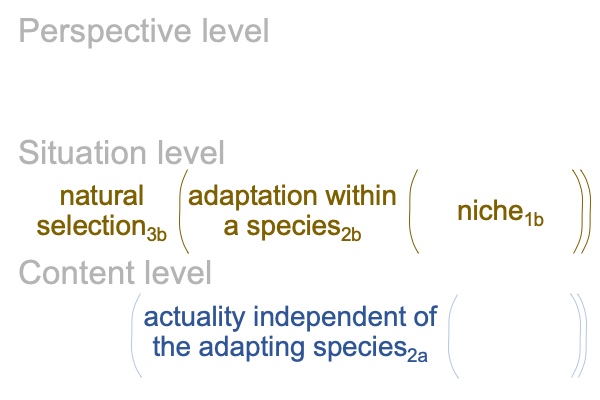
0021 The word “niche” applies to an actuality, independent of the species, that the species adapts to.  The actuality is real.  Like land and sea, a niche is independent of the adapting species.  The original species experiences this actuality as potential.  The land and sea offer the potentials of new habitats.  These potentials constitute the niche that the species adapts to.

Here, descent is assumed.  Emphasis falls on the phrase “with modification”, because natural selection operates on phenotypic variations.

0022 Is there a certain “logic” to the Darwinian paradigm?

Two actualities stand out: adaptation and the actuality underlying the niche.  They are related as situation and content, respectively.  Two nested forms are required to model the classical Darwinian idea of descent with modification.

0023 Two nested forms?

The nested form is a purely relational structure, following the logic of Charles Peirce.  See A Primer on the Category-Based Nested Form and A Primer on Sensible and Social Construction, by Razie Mah, available at smashwords and other e-book venues.

0024 Here is a diagram for adaptation, as portrayed in the preceding discussion.

0025 The normal context of natural selection3b brings the actuality of an adaptation2b into relation with a niche1b.

0026 A niche1b expresses the potential of an actuality independent of the adapting species1b.  The niche1b emerges from (and situates) a content-level actuality2a.  For ancestral water-dwelling lung fish, the actuality2a was land.  For the ancestors of the whale, the actuality2a was sea.

11/25/25

Looking at Dennis Venema and Scot McKnight’s Book (2017) “Adam and the Genome” (Part 4 of 22)

0027 According to classical Darwinism, adaptations2b are explained through natural selection.  The niche1b accounts for modifications.  Descent is assumed.

0028 At the time of Darwin, no one knew much about descent with modification.  Darwin simply contended that the babes of a breeding pair would have similar traits to the parents.  This much is obvious from animal breeding hobbies.

0029 Today, biologists know so much about the mechanism of descent that the niche is taken for granted.

Yes, the assumptions have been reversed.

0030 Venema explains descent with the analogy of a mother tongue over time.  Spoken words change over generations.  The English speaker of today would not understand the English speaker of 400 years ago.

Word spelling also changes over time.  Treuthe went to truthe, then to trueth, then to truth.  That ain’t no lie.

0031 Thus, spoken and written words show descent with modification over the centuries.  Each subpopulation of speakers shifts word locution one way or another.  Isolation between two subpopulations eventually produces two different – closely related – languages.

0032 How does this explain descent with modification?

0033 Ah, this is Dr. Venema’s area of expertise.  His writing is wonderful.  Read his own words.  Especially, note the passages where he assumes the niche.  The niche may be land, sea, as well as gunk in a waste pond.  For a virus, a niche may be… say… bacteria. 

0034 Now, I go back to the diagrams.

How does the role of DNA fit into descent with modification, as depicted by category-based nested forms?

0035 What are the actualities?

0036 DNA is one actuality.

DNA is like a book containing genes.  Genes are recipes for proteins.  Proteins build the body of a cell.

DNA also instructs the “reader” how to read the book.

DNA does not get rid of old recipes.  Old recipes merely become unreadable through various substitutions, deletions, insertions and so on.  New recipes may derive from old recipes.  They may be fashioned, whole cloth, by new instructions.

0037 Let me say this in another way.

The genotype is the potential of a DNA book, complete with recipes and reading instructions.

The phenotype is the viral, cellular, or multicellular body that a DNA book is responsible for.

0038 The “body”, or the phenotype, is the second actuality.

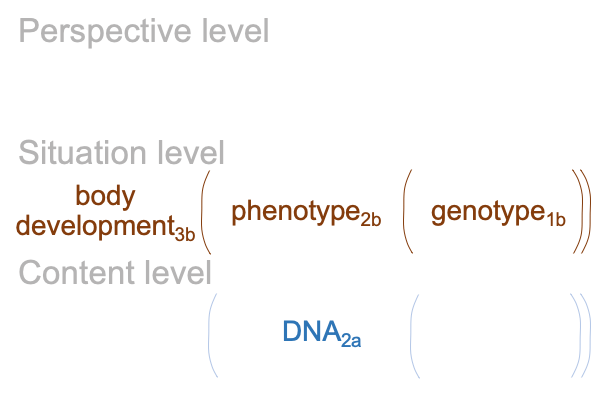
Here is a picture of the content and situation levels for the science of genetics

0039 The normal context of the biological body3b brings the actuality of the phenotype2b into relation with the genotype1b.

0040 The genotype1b is the potential inherent in DNA1b.  DNA2a is an actuality that defines the species2a.

11/24/25

Looking at Dennis Venema and Scot McKnight’s Book (2017) “Adam and the Genome” (Part 5 of 22)

0041 So, the key phrase is descent with modification.

0042 DNA2a goes with descentb.

The actuality underlying the niche2a accounts for relevance of the term, with modificationb.

0043 Phenotype2b emerges from (and situates) genotype1b.

Adaptation2b emerges from (and situates) niche1b.

0044 The fossil record contains clues to the phenotypes in any particular lineage.  The fact that DNA retains unused recipes provides clues to the genotypes in any particular lineage.  All new features gained by new species remodel already existing features of the originating species.

The fossil record also contains clues to the environment that a species adapts to.  Presumably, these clues indicate an actuality underlying the niche2a.

0045 Venema fuses the two situational actualities, phenotype2b and adaptation2b, into a single actuality.  

Phenotype2b and adaptation2b are two actualities that unite to form one: descent with modification2-combined.

0046 For example, consider the features that distinguish bats from mice.

If one examines the DNA of the bat and closely related species, one finds that their DNA differs in such a way as to explain the building of the bat body as opposed to a closely related mouse-type body.  Random mutations in DNA occur every so often, so the researcher can estimate the time distance to a common ancestor between the bat and a closely related species.

0047 If one examines caves or other locations where both bats and mice dwell, one might find fossil intermediates between bats and mice.  That would require a lot of luck and a keen eye.

0048 What does this tell us about research into the evolution of the bat?

Well, the DNA of bats and closely related species is readily available.  The likelihood of finding fossils of ancestral mouse populations that adapted to flight is incredibly small, even though caves are ideal places for fossil formation.

0049 What would I do?

Of course, I would concentrate on the DNA story and take the niche story for granted.

0050 This is what Venema does with human evolution.

11/22/25

Looking at Dennis Venema and Scot McKnight’s Book (2017) “Adam and the Genome” (Part 6 of 22)

0051 I continue to roll with Venema’s text.  I’m ignoring the niche.  Rather, I am simply assuming that a niche is operating.

In chapter 3, Venema convincingly lowers the curtain on Augustine’s concept that Adam and Eve are the biological ancestors of all humans.  He does so on the basis of DNA alone.

0052 DNA “remembers”, but not completely.  Insertions, deletions and substitutions sometimes occur as DNA is copied.  DNA is copied whenever a cell divides.  Chromosomal pairs are sorted into single chromosomes when a sperm or egg is formed.  Sperm and egg are united in the formation of a fertilized egg.

What does this imply?

The range of variation within the DNA of a species reflects the size of the breeding population.  If a breeding populationpasses through a severe bottleneck, then the result would be less variability in DNA in subsequent generations.

0053 Venema shows that, for human DNA, the breeding populations never fell below several thousand.  If they had, human DNA (at present) would show the typical pattern of a genetic bottleneck.

If that is not enough, during the Paleolithic, anatomically modern humans engaged in hanky-panky with two closely related species, the Neanderthal and the Denisovan.

0054 How else to explain the appearance of their DNA in some human subpopulations?

0055 Venema forecloses on the historical Adam imagined by Saint Augustine, where Original Sin passes from one generation to the next, through that hanky-panky business mentioned above.

0056 If there is a historical Adam and Eve, they are not the parents of all anatomically humans, living during the Paleolithic, over 50,000 years ago.

11/21/25

Looking at Dennis Venema and Scot McKnight’s Book (2017) “Adam and the Genome” (Part 7 of 22)

0057 In the next chapter, Venema notes that something remains.

0058 What about intelligent design?

0059 For me, the question should be: What about the niche?

0060 Advocates of intelligent design argue that DNA mutation alone cannot account for the dramatic changes found in the fossil record.

For example, the Cambrian Period starts with new body designs and highly modified versions of earlier body designs.

Another example is the immune system, which is very complex.

0061 Venema argues that these examples can be explained through methods other than simple mutation, such as insertion and doubling.

However, simple mutations remain foundational, because…

0062 …simple mutations produce evolution directly observed in the laboratory.

Here is an example:

0063 Imagine a culture composed of 1% of bacteria with receptor R and 99% with receptor S.  The culture is then infected with a virus that latches onto receptor-R bacteria but cannot infect S bacteria.

Well, the virus kills all the R bacteria and that is that.

0064 Okay.  Let me try that again, starting with 5% R bacteria and 95% S bacteria.

This time, the virus passes through enough generations that one mutated virus latches onto the S receptor.  Now, the virus can further adapt to the presence of the S-receptor.  The S-receptor bacteria start to die.

At the end of this petri-dish wipe-out, the virologists isolate the virus to see how it has changed.  As it turns out, the latching protein changed by 5 amino acids, meaning that its original DNA underwent at least 5 separate mutations.

0065 Note how the virologist plays god.  The virologist defines a niche1b.  The 95% S bacteria constitute an actuality independent of the virus2a, offering the potential of exploitation in the normal context of natural selection3b.

0066 Here is an example of gene doubling.

Two different species of fruit flies express different suites of transport proteins.  One has a single transport protein, deriving from a DNA-site labeled eclair.  The other has two transport proteins, eclair and p24.  The second recipe came from a doubling of the eclair DNA.  Then, the second copy underwent mutations, resulting in the second recipe for a transport protein, p24.

0067 Next, entire chromosomes may double.  Or they may break and connect to other chromosomes. 

Large-scale gene duplications go a long way in explaining huge changes in phenotype.  For example, animals with backbones came from animals with spinal cords without backbones.

0068 Finally, here is an example of the activation of a completely new recipe.

Nylon is an industrial polymer.  In the 1970’s, Japanese scientists discover a bacteria that lives off of nylon in an industrial waste pond.  The bacteria do so with a completely novel enzyme, which the scientists labeled nylonase.

0069 Venema concludes that intelligent design adds no explanatory value.  Living forms have inherent creativity in their DNA.  Simple mutations, gene duplication, and similar mechanisms account for descent with modification.

0070 Maybe, changes in genotype is the same as intelligent design.

Or, maybe, intelligent design is the niche.

11/13/25

Looking at Dennis Venema and Scot McKnight’s Book (2017) “Adam and the Genome” (Part 13 of 22)

0129 Scot McKnight offers several principles for reading the Biblical text in context.  Here, “context” means “the social and historical conditions in which the text was written”.

0130 So what is going on when one reads a text?

0131 There are two actualities.

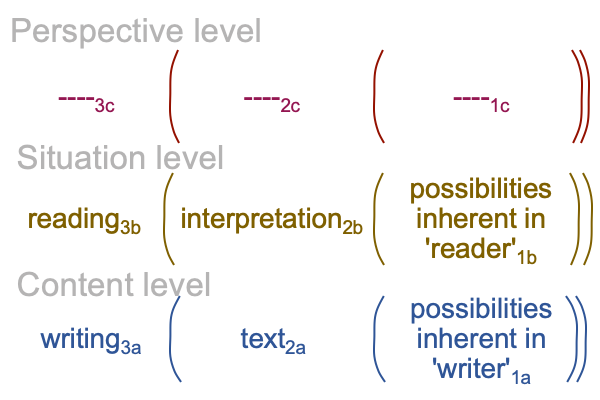
One is the text2 itself, which emerges from (and situates) the potential of an author1.  The author is subject to social and historical conditions, as well as other possibilities.

The other is an interpretation of the text2.  An interpretation2 emerges from (and situates) the possibilities inherent in a reader1.  The reader is also subject to social and historical conditions, as well as other possibilities.

0132 To me, an interpretation2 virtually emerges from (and situates) a text2, resulting in a two-level interscope.

0133 Look at that empty perspective level.

What does it imply?

0134 Consider the virtual nested form in the realm of possibility.

Something on the perspective level1c virtually brings the reader1b into relation with the potential of an author1a.

In doing so, this perspective-level something2c transcends the social and historical conditions1b of the reader2b and the social and historical conditions1b of the author2a.  The reader knows what happens after the author wrote1c.  So, the author2a reveals something2c that transcends his or her social and historical conditions1a.

0135 Does that sound like “revelation”?

Or, does that sound like “wisdom”?

0136 Consider the virtual nested form in the realm of normal context.

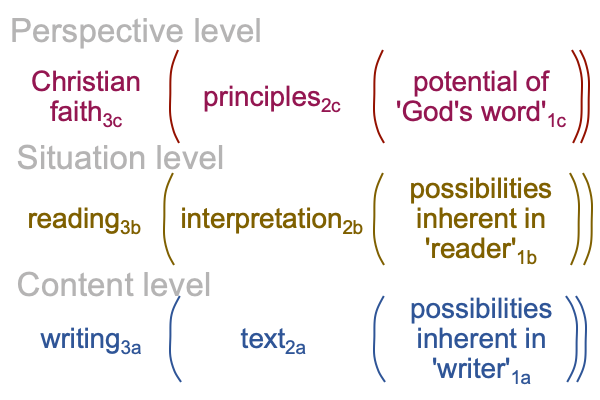
A normal context on the perspective level3c virtually brings reading3b into relation with the potentials inherent in writing3a.

0137 For Dr. McKnight, this normal context3c is Christian faith, rather than Big Government (il)Liberalism.

If I turn the column for normal context3 into a virtual nested form, I obtain a statement, saying, “The Christian faith3cvirtually brings the reading believer3b into relation with the possibilities inherent in Biblical story-telling3a.”

0138 The stories of Genesis come into being deep in history, maybe prior to the Sumerian Dynastic Period.  The Sumerian civilization is the world’s first.  Scholars know this from archaeology.

11/12/25

Looking at Dennis Venema and Scot McKnight’s Book (2017) “Adam and the Genome” (Part 14 of 22)

0139 The stories of Adam and Eve and Noah survive through a living tradition.  They are passed on by voice for generations.  They are written down thousands of years after they were first formulated.

0140 In contrast, archaeologists made some incredible discoveries in the past three centuries.  They found royal libraries of ancient cities.  These royal cities had fallen so completely that no one knew that the resulting pile of dirt was formerly a city.  Clay tablets were preserved in these tells, or “hills”, in southwestern Asia.

0141 What we now call “ancient Near East literature” was not handed down through generations in a living tradition.  Instead, it sat as indentations on clay tablets buried in the remains of ancient cities, disguised as hills by their total ruin.

0142 Before archaeologists started unearthing cuneiform tablets, no one knew of the existence of this so-called “literature”.  Neither the Jews, nor the Muslims, nor the Christians had any idea.  Augustine wrote fourteen centuries before archaeologists started working in the Near East.

0143 What did archaeologists find written on these excavated clay tablets?

They found stories similar to Genesis.  They found literary styles similar to Genesis.

0144 Now, for those interested in the living Word of God, scientific discoveries have shifted the focus of inquiry to long dead civilizations.

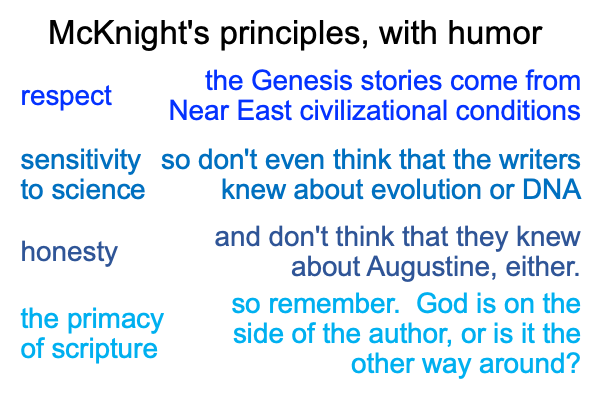
Today, we declare, “Many Genesis stories share dramatic features with ancient Near East literature.  Even more, Genesis stories share the same literary styles as ancient Near East literature.”

Welcome to the new – modern – normal context for Biblical writing3a.

0145 McKnight offers four principles that should inform the Christian reader of the Biblical origin narratives (with the [excavated] ancient Near East literature in mind).

0146 Clearly, all these principles apply to the two-level interscope of reading the text.

0147 Hmmm.  On top of that, they allow me to fill in the perspective level for reading Genesis.

11/11/25

Looking at Dennis Venema and Scot McKnight’s Book (2017) “Adam and the Genome” (Part 15 of 22)

0148 How did Augustine’s story of the historical Adam make it onto the stage?

0149 Saint Augustine did not start out as a saint.  He began as a Manichean philosopher, more or less.  He gave up that dualistic philosophy then revived it, in a strange reversal, in order to explain why babies should be baptized.

0150 The answer concerns Original Sin.  The sacrament of baptism removes Original Sin.

0151 So, what did Manicheans think about babies?

0152 The Manicheans adopted an influential Greek philosophy-laden myth to their religion of Light and Darkness.

The myth starts with a soul, sitting in bliss, in the spiritual world, above a celestial trap door.  The trap door opens.  The soul starts to fall, tumbling downwards into the material realm.  As the soul descends, matter clings to it, surrounding the soul’s immaterial beauty with crass matter, until… the baby is born.

0153 Yes, according to the Manicheans, a baby is a bundle of evil matter occluding a divine spiritual spark.  So, the goal of life is to escape the evil body and return to the source

0154 Does this scenario sound vaguely New Age?

0155 Anyway, to me, Augustine’s version of the Fall reminds me of this baby story.

0156 To start, in paradise, Adam was so rational (not not religious, but without passion) that he could command his… what we might call… privy parts.  Eve, I suppose, had to adjust to that.

“Rational” is bliss to philosophers.

0157 Then, came this serpent, who talked to Eve, because it already knew that Adam was perfectly rational, except for his one weak spot: Eve.  God’s command not to eat the fruit was a trap door labeled: the knowledge of good and evil.

0158 Adam and Eve fell, like the unsupported divine spark, into the evil, corrupt and altogether nutty material world.  Then, they had kids.  It went downhill from there.  Every one of us directly descends from that disaster.  That is why we are all subject to the deprivation of God’s original justice.

Oh, wait a second.

Does that last sentence make sense?

Check out Looking at Daniel Houck’s Book (2020) “Aquinas, Original Sin and the Challenge of Evolution”, appearing in Razie Mah’s blog for November 2024.

0159 Jesus came into a world full of Original Sin.  He institutes a sacrament, Baptism, that washes Original Sin away and redeems the… um… evil matter holding the divine spark.

0160 Yes, I am back to babies!

The Manichean tale of Augustine’s time left every mother nervous.  Many children never lived to adulthood.  When one died, the mother asked, “What will happen to my child’s divine spark?  Will it ever return to the source?  How can it escape the imprisoning occluding evil matter of that corpse?

The Manicheans had no satisfying answer. 

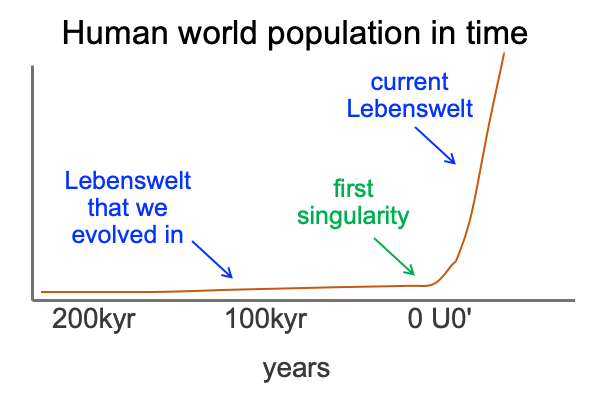
0161 In contrast, Augustine offered a way out of this dilemma.  What to do with the evil matter that is your baby?  Good news.  Baptize the infant.  God redeems matter and saves the human spirit.

0162 The reversal is marvelous.  Jesus is fully human and fully divine.  He is the union of the visible and the invisible.  How can matter be evil? 

The waters of baptism transubstantiate evil matter (that looks like a baby) into a vessel (that still looks like a baby)bearing a soul open to God’s welcoming call.

0163 Augustine routed the Manicheans.  How could they compete?

0164 Yet, he posed a problem.  How does the nastiness of Original Sin travel from Adam to me, one of his descendants?

0165 Augustine’s answer was procreation, a biological function that humans take way too much pleasure in.  Augustine personally suffered the addiction.

So, the mode of transmission became part of the descent.  Horniness became a sign of Original Sin.

0166 So, what is the historical Adam, courtesy of Saint Augustine?

McKnight lists the attributes.

Adam and Eve were two actual persons, directly created by God.  They sinned and brought death into the world.  They have a biological relation (descent with modification) to all human beings.  Their DNA is our DNA.  So, their fallen nature is our sinful nature.

0167 The problem with direct biological descent is obvious.  Whoever claims to not be a descendant of Adam would not be in need of Baptism.  That person would not need salvation.

11/10/25

Looking at Dennis Venema and Scot McKnight’s Book (2017) “Adam and the Genome” (Part 16 of 22)

0168 So, Augustine solved one challenge and created another.  The new challenge must be viewed as an opportunity.  The concept of Original Sin is a powerful defense against Manichean ideologies.  The opportunity comes, not from abandoning the concept, but by re-writing the play.

0169 Venema lowers the curtain on one side of the stage of Augustine’s play.  The science of genetics rules out Adam and Eve as the first anatomically modern humans.

McKnight aims to lower the curtain on the other side of Augustine’s play.  The archaeological discovery of an ancient Near East literature rules out the stories of Adam and Eve as literal accounts.

0170 This raises a question.  If the stories of the Fall are mythic traces of actual events, then what were these events?

Indeed, I can expand the query.  If all the written origin stories of the ancient Near East trace to one traumatic unfolding, then what was this event?

0171 Venema and McKnight are not aware that an alternate script sits right off stage.

This alternate play is a scientific hypothesis, calling for a historical fairy-tale Adam and Eve.  The hypothesis of the first singularity may or may not be true (as opposed to false).  The efforts to establish or debunk the proposal should prove dramatic.

0172 The hypothesis of the first singularity addresses this question: Why is our current Lebenswelt not the Lebenswelt that we evolved in?

0173 A Lebenswelt is a living world.  The term was coined in order to describe the cultural bubble that we humans live in.

0174 Why do I suspect that our current Lebenswelt is not the Lebenswelt that we evolved in?

0175 The archaeological record contains a discontinuity.

0176 The Ubaid of southern Mesopotamia is evident in the archaeological record by 5800 B.C.  The culture forms even earlier, but this is the year that I denote 0 U0’ (Ubaid Zero Prime).

Oh, the technical details.

Zero U0′ corresponds to the start of the Ubaid, even though the Ubaid constellated over several hundred years.  I suspect that this date will be adjusted.  In 2025, zero U0′ corresponds to 7825 years ago.  In comparison, year 0 for the Byzantine Church is 7533 years ago.  Year 0 is 6265 years ago according to the Egyptian calendar.  Year 0 for the Jewish calendar is 5785 years ago.

So, expect zero Ubaid Zero Prime to change.

Maybe it will change to 6800 B.C. or 8800 years ago.

Right now, let me stay with Ubaid Zero Prime as 5800 B.C.

Simply subtract 5800 from U0′ to get the year in B.C.

0177 Now, back to the Ubaid of southern Mesopotamia.

Around 1300 U0’, the Ubaid suddenly expands into northern Mesopotamia, taking over other Developed Neolithic sites.  This is a first.  Around 1800 U0’, the Uruk period starts as town-chiefdoms.  They invent the wheel.  They also figure out how to use donkeys for long distance transportation.  These are all firsts.  Around 2800 U0’, the Sumerian civilization starts.

0178 In the course of 2800 years, a budding village culture of the Developed Neolithic becomes the world’s first civilization.  Egypt follows the same trajectory in even less time.  The same transition occurs in the valleys of western Iran, then the Indus Valley, then along the river valleys in China.

From all appearances, something spreads from the Ubaid to the rest of Eurasia, then beyond.  Obviously, this is a cultural transition that potentiated civilization (that is, unconstrained social complexity).

0179 A graph of world-human population shows a break at 0 U0’.