11/8/25

Looking at Dennis Venema and Scot McKnight’s Book (2017) “Adam and the Genome” (Part 17 of 22)

0180 The first singularity?

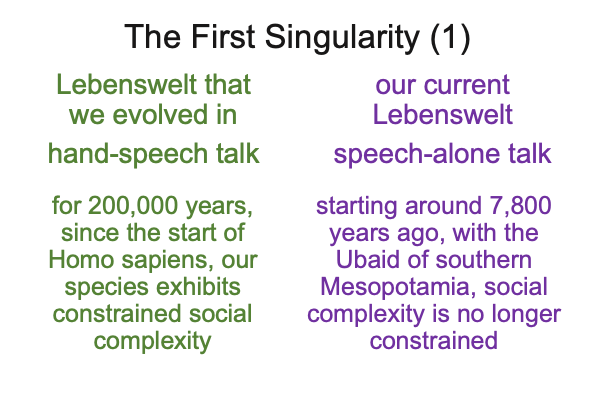
What is this something that spread from the Ubaid to the rest of the ongoing Neolithic and late Paleolithic?

0181 It is a change in the way humans talk.

0182 Say what?

The evolution of talk is not the same as the evolution of language.

0183 Language evolved in the regimen of hand talk.

Linguistic hand talk was so successful that bands could form bands of bands… er… tribes.  Tribal gatherings used the voice for rapid social synchronization.  The voice came under voluntary neural control.

0184 Then, with our own species, the voice was able to tap into the language capacity that had evolved under hand talk.  Humans are the only species that talked with both manual-brachial gestures and voice.  Both channels were fully linguistic.  I call this hand-speech talk.

For an evolutionary argument, see Looking at Steven Mithen’s Book (2024) “The Language Puzzle”, appearing in Razie Mah’s blog during September 2025, along with Looking at Julian Jaynes’s Book (1976) “The Origins of Consciousness in the Breakdown of the Bicameral Mind”.  Both works compose Razie Mah’s e-book, titled Synaesthesia and the Bicameral Mind in Human Evolution (available at smashwords and other e-book venues).

0185 Anatomically modern humans practiced their dual-channel way of talking for tens of thousands of years.  Hand-speech talk lasted through the Paleolithic and into the Neolithic.

0186 Then, in a freak social accident, starting over 7800 years ago, two distinct village cultures meld on the shores of the infilling Persian Gulf and become one culture, the Ubaid.  In the process, they lose the hand-talk channel of their hand-speech talk.  They practice speech-alone talk.  The Sumerian language is a creole.  No wonder it is unrelated to all families of languages.

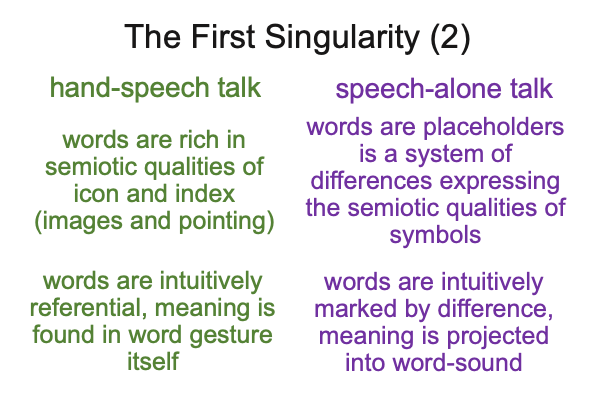
0187 The difference in semiotic (or sign-) qualities between hand (and hand-speech) talk and speech-alone talkaccounts for the potentiation of unconstrained social complexity.

0188 Here is the transition in terms of a change in the way humans talk.

0189 Yes, the semiotic qualities of speech-alone talk potentiated unconstrained complexity

0190 Before the first singularity, the iconic and indexal qualities of hand-speech talk grounded words in intuitive reference.

Everything we knew was couched in hand-speech talk.

11/7/25

Looking at Dennis Venema and Scot McKnight’s Book (2017) “Adam and the Genome” (Part 18 of 22)

0191 After the first singularity, speech-alone talk words are not grounded in pantomime and pointing.  Anyone can mint a word for anything.  This flexibility fosters labor and social specialization.  Specialization increases the wealth and the power of the Ubaid.

Here is the transition in terms of the semiotic qualities of the different ways of talking.

0192 How does speech-alone talk spread?

Any Neolithic or late Paleolithic culture can see that the Ubaid has something that they do not have.  First, the Ubaid has more wealth and power.  Second, the Ubaid people do not talk with their hands.

0193 Speech-alone talk spreads through mimicry.  It spreads like wildfire.  It potentiates unconstrained complexity everywhere it is adopted.

Then, specializations increase wealth and power. 

Then what happened?

The newly minted elites, typical of our current Lebenswelt, challenge the keepers of the Lebenswelt that we evolved in.

0194 Everything we knew from our evolution is forgotten.

Everything we know is forged in our current Lebenswelt.

0195 Imagine the darkness and confusion that follows the adoption of speech-alone talk.

Each infected population increases in number and becomes wealthier and more divided. At the same time, each population forgets who they are.  They leave behind what they had evolved to be.  A new priesthood, attending to manifold specialized deities, murders the holistic shamans who stand in the way of change.

Does this sound vaguely familiar?

0196 Writing is invented, maybe around 3000 U0’, in order to record economic transactions for the burgeoning temples and palaces.  Fortunately, for archaeologists, the Sumerians write on clay tablets, which may crack but do not decay (like papyrus).

0197 Eventually, scribes record the public creation stories of these early civilizations on clay tablets. Some of these tablets are stored in royal libraries.

The written origin myths of the ancient Near East have one feature in common.

They cannot envision times before the trauma of the first singularity.

The same goes for the stories of Adam and Eve, surviving as fairy tales in a living tradition.

In this regard, the Creation Story of Genesis One is an anomaly.  But, Genesis One comes from a different source than the stories of Adam and Eve.  See Exercises in Artistic Concordism, by Razie Mah, available at smashwords and other e-book venues.

0198 And the final point?

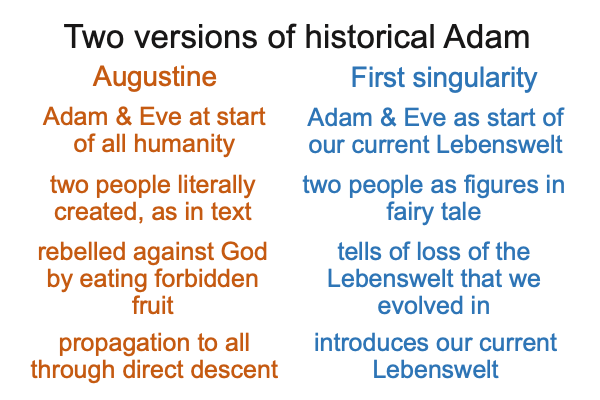
The first singularity, a scientific hypothesis, offers something similar to Augustine’s version of Original Sin.

Christian theologians now face the task of proposing Augustine’s postmodern doctrine of Original Sin, the one that Augustine would have proposed if he had the hypothesis of the first singularity at hand.

11/6/25

Looking at Dennis Venema and Scot McKnight’s Book (2017) “Adam and the Genome” (Part 19 of 22)

0199 McKnight introduces the social and historical conditions in which the stories of Adam and Eve were written.

0200 (Excavated) ancient Near Eastern literature sets the scene.  This literature includes the Enuma Elish, the Gilgamesh epic, Atrahasis and a Sumerian origin account.

These stories depict the creation of humans by various gods, right around the time when real work was required.  Real work indicates a job.  The job can be tending the fields, maintaining irrigation, or attending the assembly.  Work is a marker for our current Lebenswelt.

0201 These stories differ from the timeless cosmic circles of the North American Plains Indians and the time-fluid dreamtime of the Australian Aborigines.  They also differ from ancient holistic traditions remembered in Proverbs 8:22-31.  They differ from the visionary unfolding in Genesis 1.  Mystic participation is a marker for the Lebenswelt that we evolved in.

0202 Here is my version of McKnight’s first thesis.

The Genesis accounts present a God that both outside of historic time and inside of historic time.

0203 The God in the first chapter of Genesis corresponds to God in the Lebenswelt that we evolved in.

Indeed, humans appear in verses 1:26-30 with surprising precision.  Verse 1:26 announces the intention of humans, the hand-talking hominins.  Verse 1:27 goes with the first appearance of anatomically modern humans.  Verse 1:28 touches base with the Paleolithic era, when humans displaced (oh, a little more than that) all other hominin species.  Verse 1:29 reminds me of the beginnings of agriculture.  Verse 1:30 captures the essence of the Developed Neolithic, which combined agriculture and stockbreeding: Give plants as food to the animals.

0204 The God in the second creation story corresponds to God in our current Lebenswelt.

Yes, God is the same in both eras.  Humanity is the one that falls.

0205 Here is my version of McKnight’s second thesis.

Theomachy (battles among the gods) characterizes the (excavated) public origin myths, but not the Biblical origin myth.

0206 Why would this be the case?

0207 Public ancient origin myths account for a religious and political order established through conflict.

Genesis accounts for a family tradition.

0208 Here is my version of McKnight’s third thesis.

In the first Genesis story, the “temple” created by God is the entire visible world.  In the (excavated) public origin myths, the temple is created for a god, to make visible the invisible world.

0209 These origin stories share a style common to the ancient Near East.  Each origin story illuminates the mystery of what happened during the first singularity.  The first creation story in Genesis goes so far that it envisions the Lebenswelt that we evolved in.  Public origin myths (as well as the family stories of Adam and Eve) cannot discern times earlier than the first singularity.

0210 Here is my version of McKnight’s fourth thesis.

All humans are made in God’s image in Genesis 1.  Humans were made to do the work of the gods in the (excavated) public origin myths.

0211 Again, the first creation story glimpses through the veil of the first singularity to the condition of humans in the Lebenswelt that we evolved in.  Humans are icons of the divine nature.  Imagine how wonderful that must have been.  Imagine a world talking in images and indications, just like our own hand-speech talk.

At the same time, the (excavated) public origin myths envision humans in our current Lebenswelt.  There is a shimmer of insight into what came before.  The original state is chaos.  Chaos calls to mind the cultural changes that followed the adoption of speech-alone talk.

11/5/25

Looking at Dennis Venema and Scot McKnight’s Book (2017) “Adam and the Genome” (Part 20 of 22)

0212 Here is my version of McKnight’s fifth thesis.

Humans are not like the animals.  Humans can be reduced to animals.

0213 The first statement follows Genesis.

The second statement comes from gods creating humans to do their work.  Likewise, humans breed stock animals (like donkeys) to do their work. 

0214 During the Uruk period, a standard bevel-rimmed bowl was invented in order to give rations. The elites treated the folk like stock animals.  Work for food.  This standard bowl is found in Uruk-level excavations.

0215 Here is my version of McKnight’s sixth thesis.

After the creation of Adam, God makes Eve from Adam’s rib.  This denotes the way humans evolved to be.

0216 In the first Genesis origin story, humans were made to fill the earth and have dominion over it.  This dominion was not royal imposition.  It was a dominion in sync with the created world.  Plants and animals talked to humans in images and indications.  Humans talked to one another in linguistic pantomime and pointing.

In the second Genesis origin story, humans fill the earth and have dominion over it.  This dominion is similar to royal imposition.  Humans name the plants and the animals.  God’s creation becomes subject to human sovereign control.

0217 Here is my version of McKnight’s seventh thesis.

When God places Adam and Eve in the garden.  The garden represents the Lebenswelt that we evolved in.  Adam and Eve tended the garden. But, the garden sprouted on God’s command.

When God curses Adam with the law of diminishing returns, His curse describes our current Lebenswelt.

0218 Here is my version of McKnight’s eighth thesis.

Adam names the animals.  This naming depicts speech-alone talk.

In hand-speech talk, an animal would name itself.  Some feature of the animal would go into its gestural-name.  This is the nature of pantomime.

0219 Here is my version of McKnight’s ninth thesis.

Adam and Eve had the freedom to choose or defy God.  They had the capacity to be arrogant.  With the help of the serpent, they realized that they could be “like God”.

0220 This arrogance and grasping for power characterizes the battle between the original shamans and the priests and priestesses of the specialized religions of unconstrained complexity.

0221 The original shamans carried on the holistic traditions of the Lebenswelt that we evolved in.  Their hand-speech traditions engaged God, through natural signs.

In contrast, labor and social specialties (empowered by semiotic qualities of speech-alone talk) projected gods into the gaps of their knowledge.  They chose gods who were arrogant, power-grabbing and ready to displace the eternal gods of the shamans.

0222 Here is my version of McKnight’s tenth thesis.

The curses laid on Adam, Eve and the serpent depict our current Lebenswelt.

0223 But, worse than any of these curses, is the reality that humans no longer intuitively talk the truth.

When words are icons and indexes, they are true because they picture or point to something.  The fidelity of the word is intuitively obvious.

When words are purely symbolic, their truth depends on the entire system of differences that supports them.  This allows us to unwittingly and deceptively alter the meaning, presence and message of words.

0224 An example appeared earlier.  The word “rational” once meant “reasonable” and “without passion”.  Now, in 2025, “rational” means “anything but religious” (where “religion” means “Christian factions”).

0225 Here is my version of McKnight’s eleventh thesis.

The stories of Adam and Eve set the stage for the emergence of civilization in southern Mesopotamia.

In contrast, the ancient (excavated) public myths account for the political and religious orders of the time.

0226 Indeed, what follows the Book of Genesis is full of irony, since the nation of Israel does precisely what Eve did,believing its own projections into spoken words.

Saint Paul put the irony in a nutshell.  Once someone else (particularly God) gives a command, our clever little minds start pulling and pushing at the spoken words, hoping to get something for nothing.  We do so through our ability to name.  We create labels.  Then, we project our own meanings into the terms.  In doing so, we create our own “reality”.

And the consequences?

Later generations will suffer these.

0227 Here is my version of McKnight’s twelfth thesis.

Adam and Eve are literary and archetypal. They bear the image-of-God.

They also point, via the genealogies, to events occurring thousands of years ago, not tens of thousands.  The (excavated) literature of the ancient Near East does the same.  The fact that this living and these dead traditions are co-extensive (containing different versions of the same story) indicates common descent (followed by modification).

0228 All these stories derive from a single – worldview transforming – event, set in motion 7800 years ago (and proceeding, even now, with the loss of hand-speech talk in the North American Plains Indians and the Australian Aborigines).  This event is called “the first singularity” and marks the transition from the Lebenswelt that we evolved into our current Lebenswelt.

0229 The historical Adam envisioned by Augustine is untenable.  A historical and mythic Adam at the start of history is tenable.
11/4/25

Looking at Dennis Venema and Scot McKnight’s Book (2017) “Adam and the Genome” (Part 21 of 22)

0230 In two chapters, McKnight discusses how various Jewish writers and Saint Paul treated Adam and Eve.  Adam and Eve are real characters located in the mythic past.  Adam and Eve are literary, archetypal and bear the image of God.  They founded the Jewish people, as well as other peoples in the Near East.

0231 In chapter 5 of Romans, Paul comes eerily close to articulating the historical trajectory of the first singularity.  McKnight covers the passage in detail. Razie Mah’s e-article, Comments on Original Sin and Original Death: Romans 5:12-19, examines a similar analysis by Tom Schreiner.

0232 What does this imply?

Saint Paul senses, but does not grasp, what could possibly have generated the Adam and Eve stories.

0233 At 5800 U0’ (or 0 A.D.), no one imagined that the stories of Adam and Eve associate to a fantastic traumatic event in recent human prehistory.  No one imagined that those occasional funny hills deep in the deserts of the Near East could contain the ruins of the royal libraries of long-forgotten cities.

0234 At 6200 U0’, Augustine did not know that, either.

However, Augustine had the imagination to re-stage the stories as a play on the Manichean version of the descent of the soul.  Original Sin later became Christian doctrine.  God’s hand is in that designation.

0235 Then, the modern age of science arrived, digging up the hills of southwest Asia and fashioning classical Darwinism, then Neo-Darwinism.  The first shows that the early chapters of Genesis exhibit the literary style and some of the same themes as ancient (excavated) Near East literature.  The second shows that Adam and Eve could not be the biological ancestral parents of all humans.

0236 These two facts rule out the story of the Fall staged by Augustine.

0237 At the same time, the ruling raises the question: What is Original Sin?

0238 On one hand, modern theologians, such as Piet Schoonenberg, diligently worked in order to demonstrate that Original Sin corresponds to a combination of social conditions and personal sin.

In other words, Original Sin belongs to our current living world (Lebenswelt).

0239 On the other hand, someone had to wonder, “Why is our current Lebenswelt not the same as the Lebenswelt that we evolved in?”

0240 The genetic data shows that our current Lebenswelt is not due to a speciation event (as unwittingly predicted by Augustine).

0241 The data from excavations of ancient Near East sites shows that the public written origin stories point to a recent event occurring less than ten thousand years ago.

That event had to be cultural.  It gave rise to our current Lebenswelt.  It eclipsed and occluded the Lebenswelt that we evolved in

0242 The hypothesis of the first singularity is introduced in plain form in The First Singularity and its Fairy Tale Trace.  The hypothesis is presented in dramatic form in the masterwork: An Archaeology of the Fall.  These works, by Razie Mah, are available at smashwords and other e-book venues.