0118 So, what am I trying to say?
Why demonstrate that the Anunnaki god-system coheres to a complete category-based nested form that reconciles the major gods and many minor ones (at least the gods that appear directly in the Enlil3 creation story)?
0119 Take a look at where I’ve been.
Here are the parallels between D. Basak’s (2025) text and Beck et al.’s (2026) article.
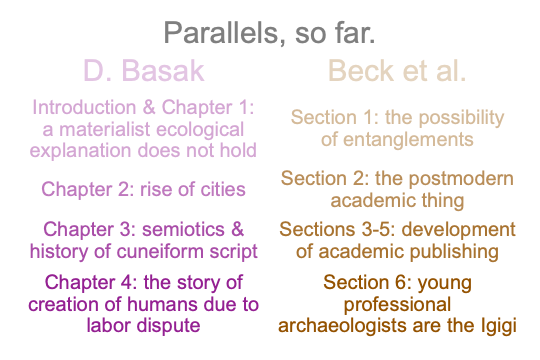
0120 These parallels tell me that Basak’s notion in chapter 1, that the ecology, geology and climate of the land between the two rivers entangles the Sumerian mind, does not fully account for the origin of Sumerian mythology. It is not the reason why southern Mesopotamia gives rise to one of the first ancient civilizations. And yet, if Basak’s book is AI generated, then that is what pre-2025 modern archaeological literature is saying.
0121 Not only that, but the same… um… potential that Enlil’s Sumerian creation myth imagines, but cannot label, seems to be operating today, as witnessed by Beck et al.‘s article. Little do these experts realize that their civilizational struggle is as old as… um… civilization itself.
The rise of urban sites during the Uruk parallels the academic thing for the past 165 years. The development of cuneiform script unfolds like the three types of natural sign-relations. So does the journal article in modern academic publishing. Finally, the woeful conditions of young professional archaeologists mimic the Igigi. Their rebellion initiates the creation of humans (in order to do the work of the Igigi). The big question is, “Who are the lullu that the gods will create in order to solve the current labor crisis?”
My guess is that they are podcasters.
0122 Next, I enter into a nested form inquiry into the Enlil creation story, with the intent to show that the Anunnaki cohere to the relational structure of the category-based nested form. The Anunnaki are the seniors gods compared to the Igigi lower gods. Even though the senior gods are apparently different, because they represent different features of humanity’s material world, each god settles nicely into a slot in a highly differentiated nested form. The actuality of this nested form consists of nested forms.
The only slot that does not have a god as a label is the potential1 underlying the ruler of the pantheon and figurehead of the Anunnaki, Enlil3.
0123 The following nested form tells me that this potential1 still operates.
And, young professional archaeologists are living it.
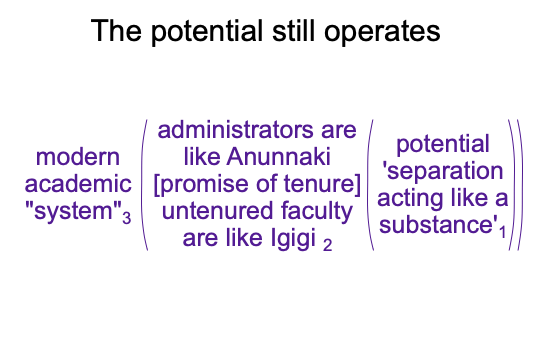
0124 Here is a problem that is difficult to face. In the above figure, the promise of tenure is the contiguity between Anunnaki-positioned administrators (including the publishing houses) and Igigi-positioned young professional archaeologists. The promise of tenure is the substance that the potential of separation manifests.
To me, the promise of tenure recalls Gilgamesh’s heroic pursuit of immortality.
Indeed, the awarding of tenure elevates a faculty through the contiguity, the substance that manifests the principle of separation, into the realm of the… how shall I say it?… senior gods.
After the coming financial deluge, there will be only one professor with tenure, and his name will be “Utnapishtim”.
0125 What do I mean by that?
Writing in the early 1800s, Georg Wilhelm Friedrich Hegel (1770-1831) figures out that the spirit3, moving over the waters, operates on the potential of a synthesis1 to overcome the dyadic actuality of a {thesis [separation] antithesis}2 in the normal context of a civilizational system3.
Perhaps, this is precisely what contemporary young professional archaeologists are calling for.
0126 Unfortunately, as long as the spirit3 does not move, the synthesis1 is postponed.
The system3 remains as is.
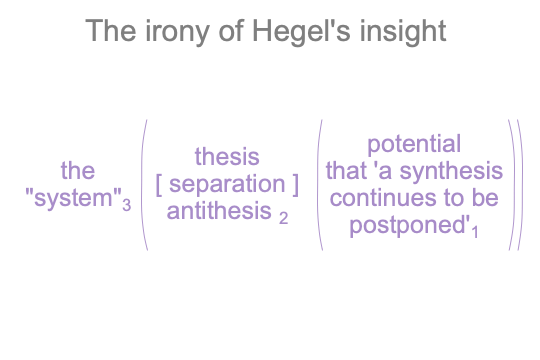
In other words, the potential of postponing a synthesis1 resides in the same location as the potential of a separation acting like a substance1.
0127 Just saying.
0128 This pathos-ridden side-comment raises a question hidden within Beck et al.’s history of the academic journal.
Are the authors asking for a solution in which tenure remains, thereby postponing the synthesis1 and maintaining the system3?
I wonder.