0065 So, where am I going with this discussion of Chapters 1 and 4?
0066 To me, the following diagram applies.
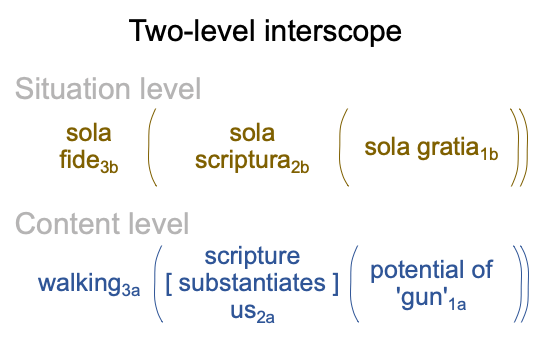
The Protestant slogan, “sola fide, sola scriptura, et sola gratia” virtually situates the title of Jones’s book, “Walking with a Bible and a Gun”.
0067 The author’s model constitutes a two-level interscope. Esse_ce associates to content. Essence associates to situation.
For instruction on this purely relational structure, consult Razie Man’s e-books, A Primer on the Category-Based Nested Form and A Primer on Sensible and Social Construction. They are not long and will help immensely.
0068 On the content level, the normal context of walking3a brings the actuality of the Bible2a into relation with the potential of ‘the gun’1a.
On the situation level, the normal context of sola fide3b brings the actuality of sola scriptura2b into relation with sola gratia (the potential of grace alone)1b.
0069 Yes, sola gratia1b labels the potential of grace alone1b.
Plus, I already know that, in Jones’s mantra where existence precedes essence, grace is never alone.
0070 I review.
Jones’s dyad derives from Aristotle’s hylomorphe.
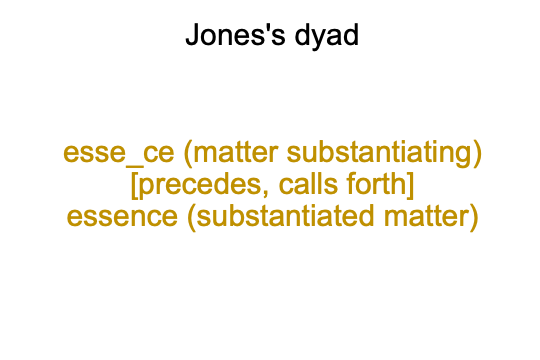
0071 If I imagine that esse_ce corresponds to the book’s title, “walking with a Bible and a gun “, and, essence corresponds to the slogan, “sola fide, sola scriptura et sola gratia “, then I can say that the American identity calls forth the Protestant reformation.
Hmmm, this seems to be the very opposite of what the author claims.
However, if the esse_ce of content calls to mind the essence of situation, then the following intuitively satisfying dyad results.
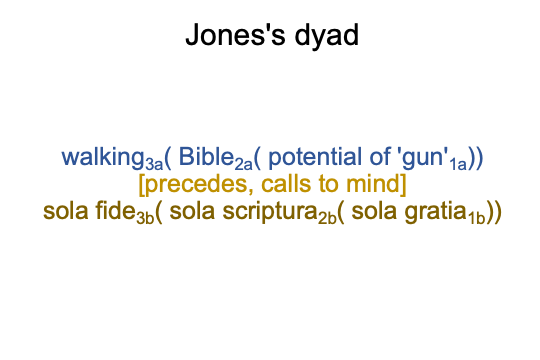
0072 “Walking with a Bible and a gun” intuitively calls to mind the slogan “sola fide, sola scriptura, et sola gratia”.
Content (esse_ce) [calls forth] situation (essence).
I think that provides an insight into the Introduction and Chapter 4.
0073 What else?
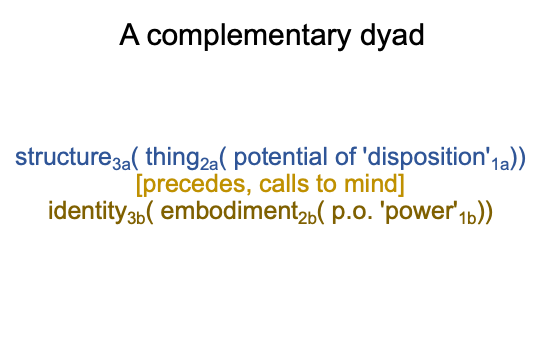
I suspect that there is a dyad that complements the above dyad. Plus, this complementary dyad contains the term, “identity”. This dyad derives from a post by an independent scholar, responding to a 2025 article on hylomorphism by Mariusz Tabaczek O.P., titled “Contemporary and Classical Versions of Hylomorphism: A Critical Evaluation”.
0074 Here is a picture.
0075 What does this imply?
These two dyads complement one another. They are not identical. They do not perfectly align. Rather, they offer two relational structures, one from an expert in literary analysis and one from a respondent to Aquinian philosophers. Both can be used in examining this book.
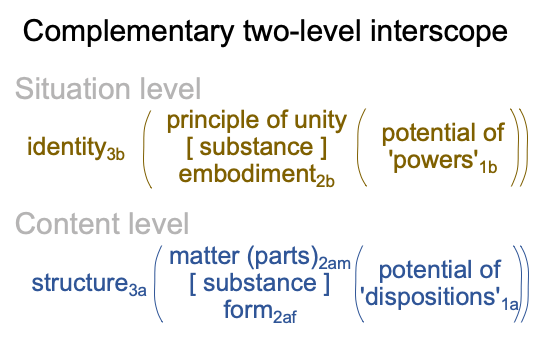
For example, the esse_ce of the title of Jones’s book provides a structure3a for a thing2a, according to the thing’s dispositions1a. The essence of the Protestant slogan provides an identity3b for an embodiment2bf, according to the embodiment’s powers1b.
0076 Further, the dyad opens into a two-level interscope that complements the interscope attained from examining the Introduction and Chapter 4.
0077 Students should now read Chapter 1.