Category Archives: Our current Lebenswelt is not the Lebenswelt that we evolved in
Human psychology evolved under in the social milieu of constrained complexity. Currently, humans live in unconstrained complexity. What has this done to our minds? These topics are addressed in various parts of An Archaeology of the Fall, particularly in chapters 8C and 11B.
0015 Does Aquarius touch base with the first singularity?
Capricorn is half-goat and half-fish, which corresponds to the dual earth-water origin of the Ubaid culture, 7821 years ago.
The Greeks do not capture this image with their story of Pan being caught in an alternate chimerism.
0016 Neither do the Greeks capture the nature of how Aquarius resonates with the origin of astrology within our current Lebenswelt.
Ganymede is a youth so handsome that he is taken up to be the cupbearer for the Greek gods. So Aquarius is symbolized by a youth pouring water from a jug onto earth.
0017 Ah, it turns out that in Babylon, the god Ea carries an overflowing vase of water. This is the same Ea that is associated with both land and sea in Capricorn. And, this is the same Ea that is associated with the primordial waters.
0018 So, bearing jugs of water for the gods?
In one Mesopotamian origin myth, humans are created in order to do the work that the gods were tired of doing.
Is that what is in store for the next 200 years?
0019 Against this speculation, the sign of Aquarius is an air sign, rather than an earth or a water sign. So, where does Ea fit in with the creation of the air.
What does pouring water have to do with giving birth?
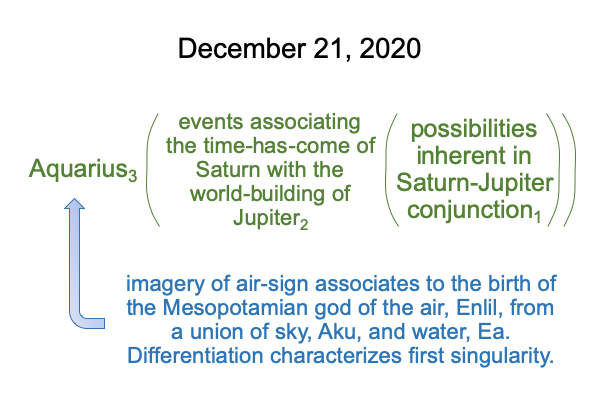
In one ancient Mesopotamian myth, Enlil, the god of the air, is born from the union of Aku, the sky, and Ea, the water.
0020 Ah, that is more like it.
Aquarius touches base with the birth of unconstrained social complexity. Unconstrained social complexity has the character of the weather, the air, the storm and the wind. There is no telling how the spirit moves. But, drop a coin into an astrologer’s hand and you may hear how the sun, the moon, the planets and the constellations put your turbulence into a celestial perspective and divinized opportunities.
0021 So, the conjunction of Jupiter and Saturn, in the sign of Aquarius, in December 2020, also resonates with the start of our current Lebenswelt. Enlil is born again.
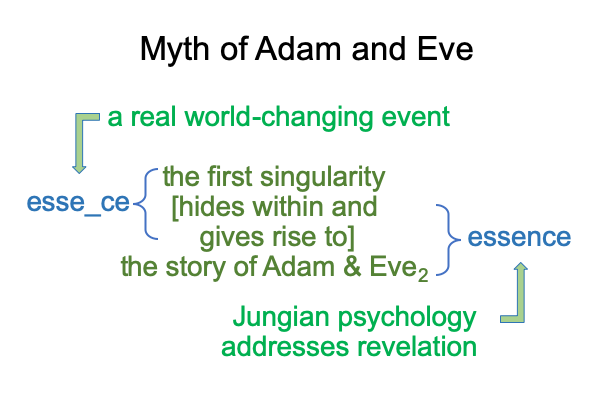
0050 The myth is hylomorphic. So is the phantasm1b that the myth’s telling1a inspires.
The hylomorphism of the myth1a is some real event [hides within and gives rise to] a story.
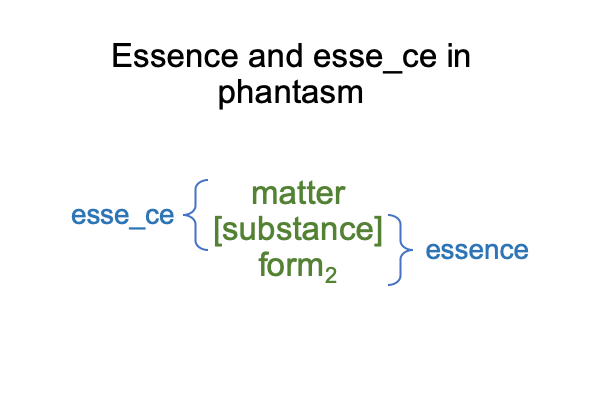
The hylomporhism of the phantasm2b is a configuration of matter and form by way of the imagination1b. Matter or being (in Latin, ens) should substantiate the form.
0051 Here is how that looks.
Figure 13
0052 What does an independent corroboration of the stories of Adam and Eve accomplish?
It changes what is happening3a by revealing an esse_ce that lends the story2aa realness that we cannot ignore1a.
To the modern, the stories of Adam and Eve are suppposed to be fairy tales. Adam and Eve are not supposed to serve as harbingers of civilization. They are not supposed to be weirdly consistent with a scientific hypothesis on the potentiation of unconstrained social complexity, that is, the first singularity. They are not supposed to be witnesses.
In light of the first singularity, the Genesis myth becomes counterintuitive to the modern imagination. It becomes monstrous. Essence without esse_ce can be ignored. Essence with esse_ce cannot.
0053 Strangely, this may be one of Lonenecker’s subtle contentions. As soon as one adds esse_ce to essence, a fantasy becomes more real than previously imagined. Myths may become monsters.
The same surprise works for the phantasm generated by the myth. The monstrosity of a monster comes from an unanticipated balance between esse_ce and essence.
0054 Premodern monsters have this character.
For example, the minotaur is a monster dwelling within the labyrinth of King Midas. The minotaur is half-bull and half-human. Its esse_ce is human. Its essence is a bull.
What a monster!
But, there is something natural to this monster, because it informs us of a familiar actuality, the matter of a human [substantiating] the essence of a bull. Here is a monster worth pondering. Where does the word, “bully”, come from?
Premodern monsters have an imbalance between esse_ce and essence.
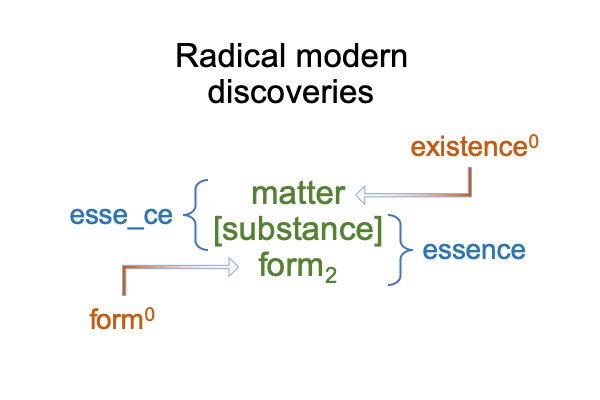
0055 Moderns take this imbalance to the limit, making two radical discoveries. Both discoveries are built on one insight. We can lose touch with the contiguity between matter and form. We have discovered (indeed, even actualized) worlds without substance.
I label these two discoveries, the zeroth order of existence and form. I label then existence0 and form0.
This is how they work.
Figure 14
0056 Existence0 is esse_ce without substance.
Form0 is essence without substance.
Work serves as an example.
Humans are designed to work. Work gives people purpose and honor. Work goes with the essence of a civilized human.
So, what is work without humans?
What is pure work without substance?
May I mention the industrial revolution?
How modern can I get?
The modern era is full of monsters.
0057 Machines do work. Then, humans work machines. Sometimes, this takes great skill.
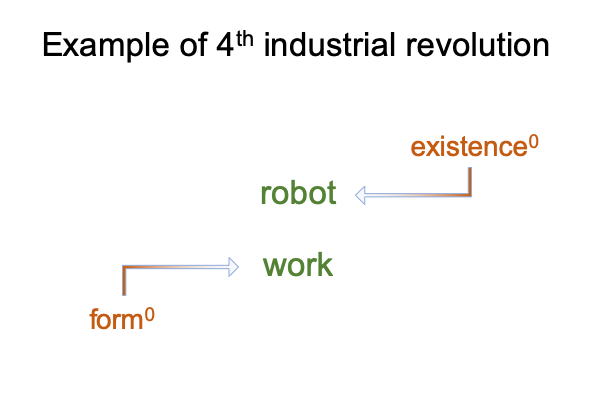
Now, with robots, humans get in the way. The robot is awarded the status of purpose and honor. Today, postmodern economists call the robots, “the fourth industrial revolution”. Make room for the pure existence0 of robots and the pure form0 of robotic work. Robots are not aware of what they are making. Robots do not know why they are working.
0058 Here is a picture.
Figure 15
0059 How does this play out in our phantasms?
Humans become less than human.
Consumers are a type of monster. We choose among flavors of peanut butter without knowing what a peanut is.
One may reply, “Robots manufacture things that consumers buy. So this is an essence.”
Here is an essence that denies humans the dignity of work, turning humans into things (that is, consumers).
Savor the word, “consumer”.
0060 A consumer dies, leaving an estate filled with manufactured momentos, icons of life as a consumer. This monstrosity must be dealt with. Maybe a robot can be designed to do the job. The sheer bulk of the consumer’s life weighs down the world. Imagine the cynicism required to build a robot that performs this work.
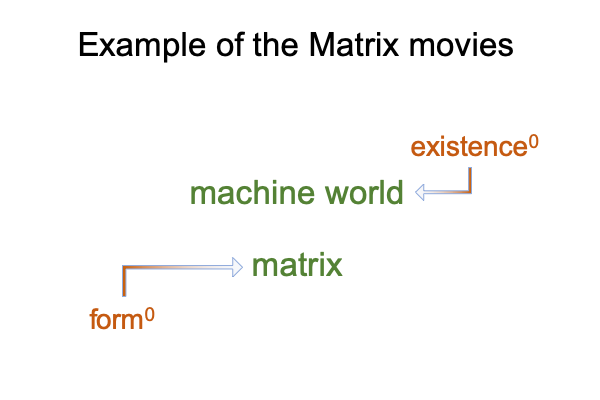
0061 The sequence of movies, titled “The Matrix” (1999), portrays a cyncial resolution to these two great philosophical discoveries. The human becomes (1) a battery that powers a machine world and (2) the one who accepts the illusionary works of the machine world. The matrix is the deception that allows humans to be used as batteries.
0062 Both the machine world and the matrix are monsters.
Figure 16
0063 In these movies, the hero’s journey gives substance to these twin monsters through a sacrifice. This is not any sacrifice. This is a human sacrifice. In doing so, the hero humanizes the two monsters. He provides substance, allowing the monsters to continue for another iteration.
If Rene Girard is correct, this plotline is as ancient as the most ancient civilizations. This plotline begins with the first singularity.
0064 Modern monsters are exemplars of things without substance.
Where does substance come from?All substance flows from God. God’s grace pours into the interstices between matter and form, body and soul, and a real event and its myth. Substance is the contiguity between being and form. God is foundation of substance.
Many Jungian commentators of the Matrix movies say that the hero, named “Neo”, is a Christ-like figure.
Is the comparison appropriate?
If it is, then Jesus gives substance to twin monsters through a human sacrifice. In doing so, he humanizes them.
0066 What are the monsters?
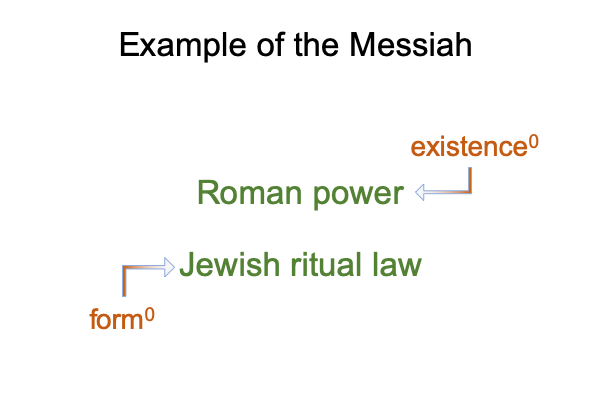
The Roman empire is like the machine world.
The fixation of the Jewish law into ritual is like the matrix.
Here is a picture.
Figure 17
0067 Every monster is an actuality2. Every monster is an ill-proportioned thing. Esse_ce and essence are out of balance. That tells us something. It produces phantasms that serve as warnings.
0068 Remember the minotaur?
Do you have some money to invest?
Most investors have met a minotaur. He is someone so bullish that it makes him dangerous. He survives in a labyrith of rules, conditions, and documentation filled with fine print. Once your money is in, it cannot come out of the investment. The financial minotaur is completely confident. He is fully capable of losing your investment.
0069 Longenecker may talk about monsters like the minotaur.
0070 Perhaps, he will talk about the most horrifying monstrosities. These monsters lack substance. Such is the case for the monsters of Roman power and Jewish ritual law.
Roman power is like esse_ce without substance. Rome serves the order that it imposes. Sure, Romans pay tribute to their gods. But, their gods did not order them to construct an empire. Roman power survives because trade flourishes under its rule. Romans place tariffs on trade. Romans rule foreign subjects and tax their wealth. Romans take slaves and sell them at their markets. How does this serve Jupiter?
Jewish ritual law is like essence without substance. Self-described scholars examine the Pentateuch for legal proscriptions. By the time of Christ, scholars accrue lists with hundreds of regulations. There is no way that a Jew could fulfill all these proscriptions correctly. Of course, wealth provides options. One can hire a scholar to manage one’s divine legalities for a reasonable fee.
That fee, of course, is unreasonable for the common person.
0071 Roman power is existential, existence0.
Jewish legalisms are formalisms, form0.
0072 Is there a relation between these two monsters?
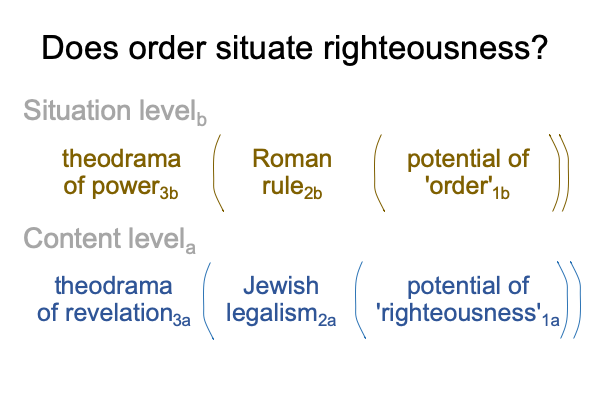
At first, it seems that Roman rule2b situates Jewish legalism2a. Standard histories of first-century Palestine make this assumption. These histories try to establish what happened. They propose material and instrumental reasons for conditions and parameters.
In the context of modern history, the following sensible two-level interscope applies. The following configuration is one answer to the question, what does this mean to me3b. That answer is proximate. It addresses the esse_ce, not the essenceof history.
Figure 18
0073 There are other answers. After all, history does not reduce to conditions and parameters. Is there an essence to history?
These are the answers – or perhaps, the questions – that Longenecker addresses.
In the context of what it ultimately means to me3b, Roman law2 does not situate Jewish legalism2. One monster cannot honestly situate the other, because something is missing on a higher level. Rome does not have righteousness and Jerusalem cannot impose order. What brings them into relation?
0074 The passion of Christ, depicted in the four gospels, is masterful. It reads like a fantasy. It reads like a historical document. The four gospels embody and transcend myth.
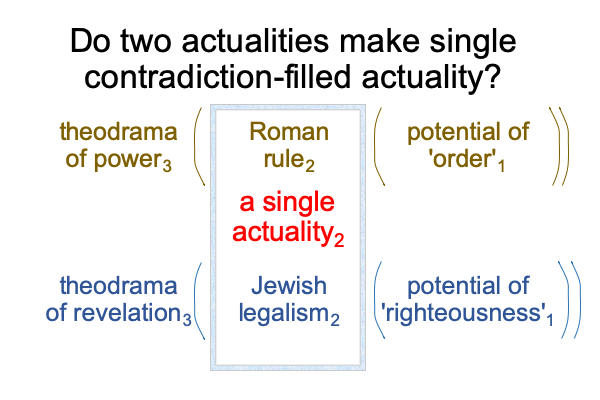
Both Roman rule2 and Jewish legalisms2 play out in the contradiction-filled theological and political arenas of first century Jerusalem. Jerusalem is a provincial capital for Rome. Jerusalem is the center of message, meaning and presencefor the Jews.
0075 Two monsters occupy Jerusalem. Each accommodates and resists the other. Neither wants to see anyone like Jesus. Jesus appears to threaten Roman order. That is easy to accomplish. Gathering a crowd will do. Crowds intimidate the lion. Also, Jesus obviously undermines the letters of Jewish legalities. He upsets the sheep. He insists that the Jewish Law has a substance, a moral and theological vision.
0076 Monsters do not necessarily create mysteries. No, monsters are drawn into mysteries.
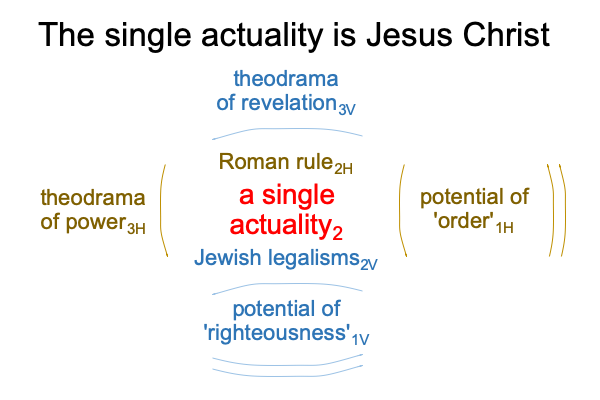
One way to appreciate how Jesus unites both Roman rule2 and Jewish legalism2 is found in a permutation of the previous diagram.
Figure 19
0077 In the life and passion of Jesus Christ, Roman rule2 and Jewish legalism2, one monster filled with esse_ce and the other full of essence, are drawn into a single actuality2. For this moment in history, two monsters coalesce. This is the type of event that eventually leads to myths. It happens right before the eyes of the disciples.
0078 What is this single actuality2?
If Roman rule2 does not honestly situate Jewish legalism2, or visa versa, then they cannot align. Their normal contexts3are mutually exclusive. They may accommodate one another. But, in the encounter with Jesus, they coalesce, forming a single actuality that resists Jesus.
This is the way of theodrama3. The essence of history is theodramatic.
The theodrama of power3 appears independent of the theodrama of revelation3. Until, of course, they are not. They are never independent in the eyes of God. They are never independent in the presence of God.
0079 Intersections are mysteries. Intersections are described in the chapter on message in How To Define the Word “Religion”.
Here is a picture of the intersection.
Figure 20
0080 Indeed, before the eyes of the disciples, Roman law2 and Jewish legalism2 coalesce into one intersection, one mystery.
What is the single actuality that labels this intersection?
The most appropriate label is the name of Jesus Christ, who rises from the dead to defy Roman rule2 and who offers a pathway to the Father in defiance of Jewish legalism2.
0081 In mythic terms, Jesus tames two monsters. The lion lies with the lamb. The power of the state and the legalism of religious institutions come into conflict, but that conflict is contained within the object that brings us all into relation, Jesus Christ.Without Jesus, two monsters are set loose upon the world.
0082 Longenecker introduces a podcast entitled “Myths, Monsters and Mysteries”. My guess is that he intends to proceed through these three topics using insights from Jungian psychology. This is good, but not complete.
Jungian psychology addresses essence. Longenecker may argue that if the essence is convincing, in terms of patterns of the human psyche, then esse_ce needs not be actual. He may argue this even though his previous independent research locates the magi, not as Persians, but as traders living between Persia and Israel.
0083 Myth has a hylomorphic structure, requiring attention to both esse_ce and essence. Without substance, the myth becomes a fantasy (pure essence) as opposed to a historical documentary (pure esse_ce).
0084 The doctrine of original sin rests on the esse_ce and essence of the Genesis stories of Adam and Eve, even though they are fairy tales.
Augustine paints Adam and Eve as the first humans.
The hypothesis of the first singularity pictures Adam and Eve as fairy tale figures that encapsulatethe theodramatic appearance of the Ubaid culture. Speech-alone talk is realized and sets the Ubaid on an irreversible course towards unconstrained social complexity.
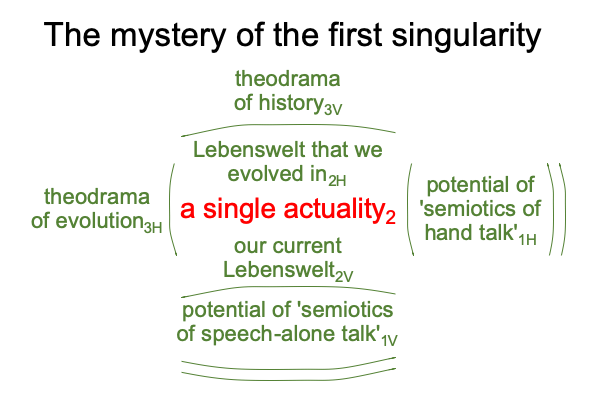
0085 In terms of mystery, a single actuality forms out of two. The Lebenswelt that we evolved in intersects with our current Lebenswelt.
Figure 21
0086 This intersection depicts the first singularity. Adam and Eve stand at this intersection. So does the esse_ce and essence of the doctrine of original sin.
The myth Adam and Eve is a fairy tale. As such, the metaphor of grain of sand [hides within and gives rise to] a pearlapplies. The oyster is the human mind. The oyster is also our world of unconstrained social complexity.
0087 In sum, the stories of Adam and Eve bring us to the beginning of our current Lebenswelt.
Ours is a world of mysteries.
Ours is a world of monsters.
Ours is a world of myths.
0088 A grain of sand hides within and gives rise to a pearl.
Figure 22
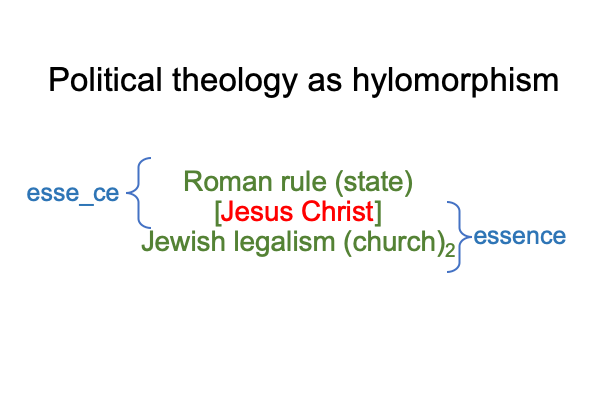
00892 The myth of Adam and Eve sets the stage for the two monsters that Jesus brings into one. Roman rule2 is all about state power. State power maintains order1. Jewish legalism2 is all about the routinization of righteousness1. Legalities2confer righteousness in the eyes of God1.
Jesus Christ stands as the single actuality2 containing Roman rule2 and Jewish legalism2. This intersection serves as the starting point for all political theology. In Roman rule2, the state does not serve the people. In Christian political theology, it does. In Jewish legalism, the deed does not stand for the intention1. In Christian ethics, it does.
Jesus is the one who tames the two monsters of state and church. One without the other leads to catastrophe. Both without Jesus leads to devastating conflict.
0090 In sum, political theology transforms one of the mysteries of Jesus Christ into a hylomorphism, a thing to be discussed and explored.
Here is a picture.
Figure 23
0091 Myths are like pearls, expressing both esse_ce (being as existent) and essence.
Myths offer monsters to perceive.
Our perception of monsters allows us to appreciate imbalances between esse_ce and essence.
0075 The most horrifying monsters are articulated in the modern era. They are existence0 (esse_ce without substance) and form0 (essence without substance).
They are not confined to the modern era. Indeed, they have been here since the beginning. They include Roman rule2and Jewish legalism2.
The life and passion of Jesus Christ takes on the characteristics of myth. Jesus brings two historic monsters into a single actuality. Jesus both contains and transcends these monsters. Jesus serves as their intersection. All roads lead through Christ.
Political theology brings this mystery back into Aristotle’s hylomorphism. The mystery becomes a field of inquiry. That inquiry is called, “political theology”.
0076 This concludes my comments on Fr. Dwight Longnecker’s Podcast (2020) on myths, monsters and mysteries.The progression from myths to monsters to mysteries constitutes a profound insight that inspires these comments. My gratitude for Fr. Longnecker’s intiative.
0001 Yoram Hazony publishes a six part opinion piece, concerning the relation between Enlightenment traditions and Marxism. on August 16, 2020, in the Quillette website (http://vlt.tc/41uo). The essay is eye-catching for its portrayal of the capture of liberal institutions by marxists (now, with a small “m”) during the past three-score years. Marx is back in a big way.
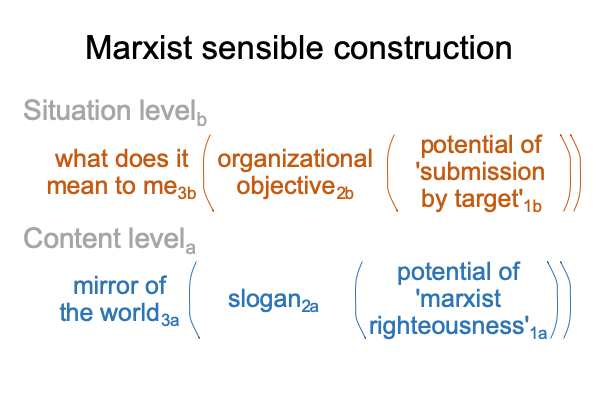
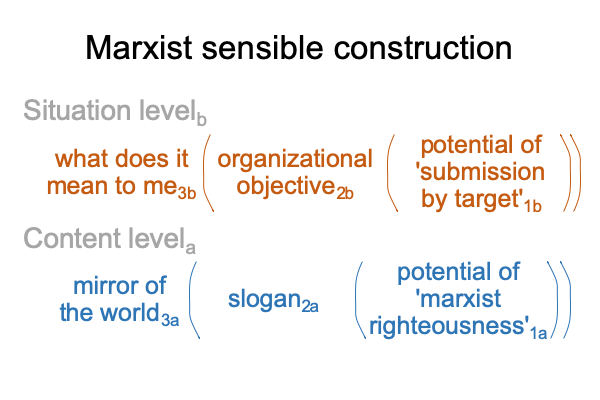
0002 In the prior blog, discussing the Be Little Men movement, two actualities come to the fore. The first is a slogan2a, based on righteousness1a, that addresses the mirror of the world3a. The second is an organizational objective2b, telling what the slogan means to the marxist3b. This objectorg2b arises from the possibility of submission1b. Submission1bvirtually situates (and emerges from) marxist righteousness1a.
0003 Here is a picture of the two-level interscope, composed of two nested forms, following the style in A Primer on the Category-Based Nested Form.
0004 According to Hazony, marxists have infiltrated American media companies, universities, government bureaucracies, courts, so-called profits, so-called non-profits and churches. Classical liberals have lost control of their own institutions. Classical liberals do not have the intellectual or spiritual resources to combat the threat.
0005 How should I define the righteousness of the classical liberal?
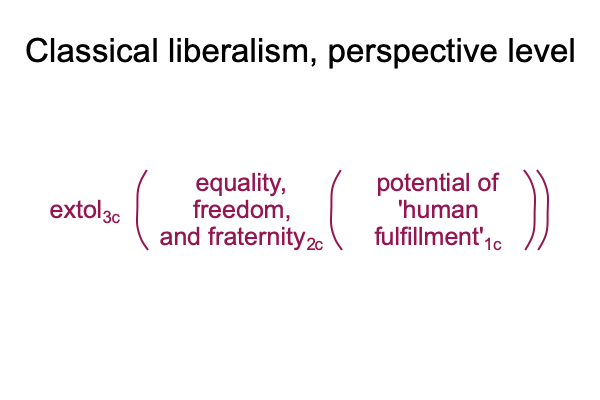
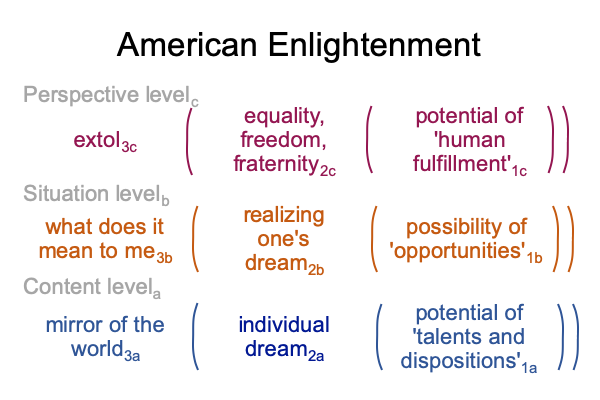
The classical liberal entertains a perspectivec that occludes the foundational world of Christianity. The classical liberal extols3cequality, freedom and fraternity2c. These2c are the means to human fulfillment1c.
The American Bill of Rights declares life, liberty and the pursuit of happiness. Equality is the right to life and justice. Freedom is the liberty to make one’s own choices. Fraternity involves private property. One must own the possessions that one shares with family, friends, teammates and other social circles. Otherwise, one usurps.
0006 The classic liberal perspective-level nested form looks like this.
Figure 2
0007 Surely, this perspectivec level does not contextualize marxist contenta and situationb levels.
Why?
Hazony speaks of two steps. In the first step, the Enlightenment covers up Christianity. In the second step, Marxism occludes the Enlightenment.
So, let me start at the first step.
Christian social virtues describe what God reveals about human sociality. Saint Paul discusses equality in his letters. Christ frees humans from the chains of original sin. The body of Christ, the Church, possesses an object that brings all into relation. Finally, all these actualities emerge from the potential that a human can attain eternal life with God, the ultimate fulfillment.
The Enlightenment makes these virtues immanent.
0008 What does this immanence entail?
How does the Enlightenment perspective play into situation and content levels?
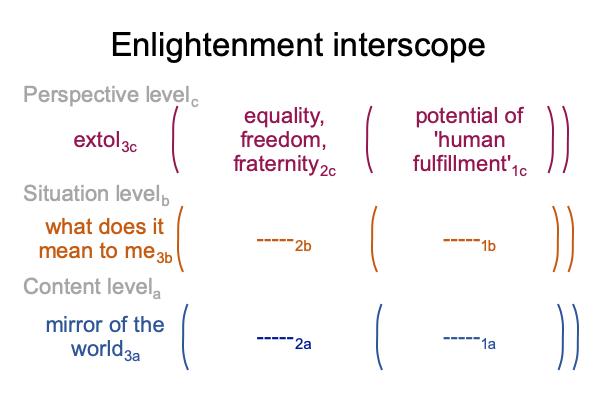
0009 First, let me simply slide the normal contexts of the situationb and contenta levels of the marxist sensible construction underneath the Enlightenment perspectivec level. Here is the resulting three-level interscope, a relational structure discussed in A Primer on Sensible and Social Construction.
Figure 3
0010 Second, I fill in the blanks.
The content level actuality2a turns extols3c into a dream2a, an object associating with an individual’s future, choices and companions. The individual’s dream2a arises from talents and dispositions1a.
What possibility1b situates the individual’s dream2a?
Of course, there must be opportunity1b.
Then, with hard work and luck, one realizes2b that dream2a.
0011 This sounds so American. Here is the interscope.
Figure 4
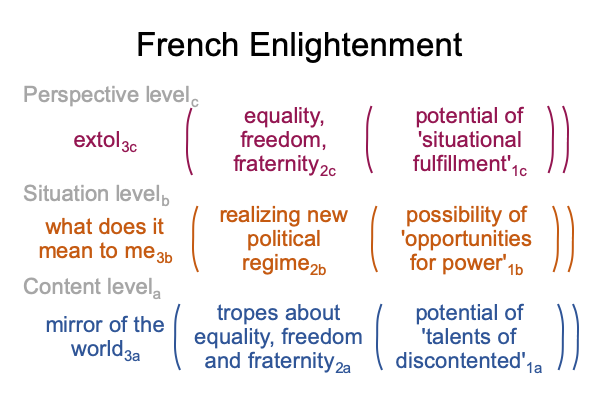
0012 The French Enlightenment, on the other hand, rots as it ripens. Unlike eighteenth-century America, France is loaded with god-defying intellectuals, salon-attending little royals and cunning lawyers, who dream of running political affairs without the burden of king and church. They have talents and dispositions1a toward promoting organizational objectives2bbased on reason1b. Reason1b gives opportunity to righteousness1a. As such, their dreams2b,2a are tautological.
The Marxist frame, perceptively delineated by Hazony, develops in situ within French Enlightenment civilization. The sarcastic godless intellectuals, self-absorbed gossip-bearing little nobles and the reason-worshipping lawyers consider themselves to oppressed by the oppressors, king and church. King and church express a false consciousness. The system works for them, not everyone else, especially the discontented. Revolution will reconstitute society and the inherent ironies of the present regime will disappear.
0014 Part 3 concerns the attractions and power of marxism.
The individual is attracted to classical liberalism.
The discontented are attracted to marxist (il)liberalism.
The current iteration of marxist religion is Big Government (il)Liberalism (BG(il)L).
0015 What do marxists have that liberals do not?
Here is a picture of the marxist’s sensible construction
Figure 6
0016 Where is the perspective levelc?
Is it too horrible to view?
The Enlightenment perspective-level actuality (equality, freedom and fraternity2c) addresses three important aspects of human sociality in our current Lebenswelt.
0017 According to Marx, these are not sufficient.
What else is required?
First (A), people form cohesive classes or groups. May I call them, “institutions”? Second (B) these classes or groups invariably oppress and exploit one another, culminating in one (the state) enforcing order. Third (C), the state eventually functions as an instrument of the oppressing class.
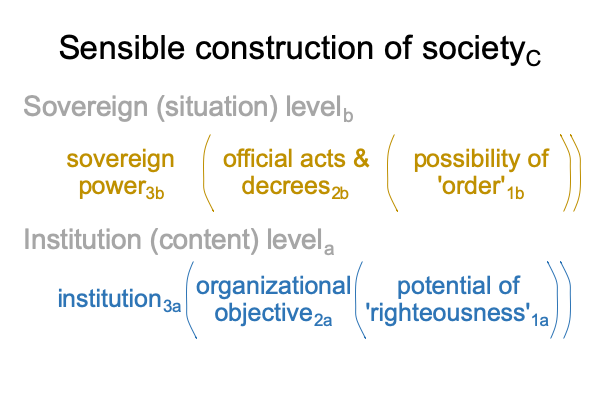
0018 Weirdly, Marx’s insight is captured in the chapter on presence in the masterwork, How To Define The Word, “Religion”. The three elements appear in the institution (content) and sovereign (situation) levels of the societyC tier.
Figure 7
0019 In theory, Enlightenment liberalism achieves order1b, while using the fewest official acts and decrees2b. It cultivates personal commitments2a to life (equality), liberty (freedom) and the pursuit of happiness (fraternity)2c. Civic culture consists of various fraternal institutions3a, some Christian (“religious”) and some not Christian (“not religious”)1a, pursuing diverse objectives2a.
Righteousness1a does not arise from within Enlightenment liberalism. Rather, Enlightenment liberalism is conducive to a wide variety of inspirations. Liberal righteousness1a demands that each individual pursues opportunities1b offered by competing civic institutions3a according to their talents and dispositions1a.
0020 In contrast, the Marxist vision proposes that a number of otherwise civic institutions3a (A) will pursue organizational objectives2a (B) that require official acts and decrees2b for their implementation1b (C).
0021 Hazony offers examples.
Ideally, public education should be implemented through a general decree stating that all individuals over a certain age must pass a civic exam in order to gain citizenship. The exam would be offered by (not one but) a suite of competing voluntary institutions, each operating with transparency due to competition. Education may be subsidized by vouchers to parents.
In practice, modern education engages unionized teachers (A) who demand a monopoly over “public” instruction and examination, as well as a host of other organizational objectives (B), that require state enforcement through official decrees (C).
In sum, Big Government (il)Liberal education exemplifies the Marxist vision.
0022 Hazony offers other examples. But, the point is clear. Marxist righteousness1a sensibly constructs organizational objectives2b, that, on one hand, arise from directly from the potential of submission by a target (individuals or institutions)1b, and, on the other hand, are virtually situated by official acts and decrees2b in the sensible construction of societyC.
0023 One reason why Marxist ideas are so attractive is that they promote a righteousness1a that both demands submission from others1b and entangles sovereign power3b.
The task of identifying like-minded individuals is relatively easy, since conservatives, Christians, nationalists and (above all) enlightened liberals espouse other styles of righteousness1a. All institutions in a modern civic society are vulnerable to infiltration by marxists.
In sum, marxists can easily identify one another, selectively promote one another, and humiliate perceived competition within each institution. Those who are not marxist within each institution are increasingly expected to toe the party line and to promote entanglements with sovereign power.
0024 Amazingly, Enlightenment liberals find themselves dispossessed by the very institutions that they built.
Does this imply that the marxists hold a perspective-level actuality2c that (if you will excuse the pun) trumps equality, freedom and fraternity2c?
0025 Hazony points to the obvious. Humans evolve in social circles where there are many relationships between a more powerful individual and a less powerful one, starting with mom, dad and their children. The organizational structure of this foundational institution is discussed in A Primer on the Family.
0026 The family starts in the Lebenswelt that we evolved in. So, there is more.
We must add the unconstrained social and labor specializations that characterize our current Lebenswelt.
Our current Lebenswelt is not the Lebenswelt that we evolved in.
0027 The organizational structures of civilizationB is a topic worthy of consideration. The institutionaC and sovereignbClevels of the society tierC contextualize the organization tierB. The organization tierB encompasses productionaB, exchangebB and assessmentcB. The organization tierB emerges from (and situates) the individual in communityA.
Too bad inquiry into the organization tierB is yet to be initiated.
Advancements are blocked by marxist theory, in its various guises. Marxist theory offers a “scientific” model that forecloses intellectual exploration of the organizations tierB.
0028 The model goes like this:
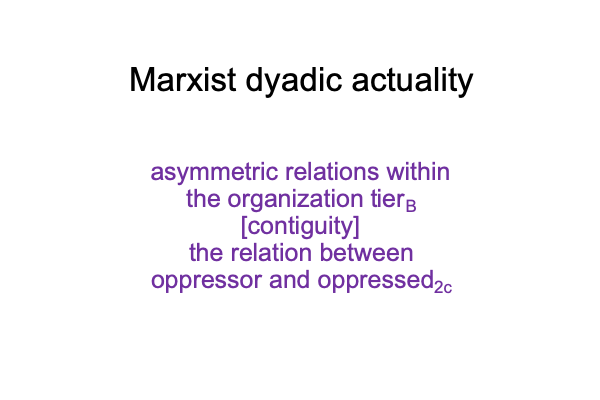
The diverse relations between more powerful and less powerful individuals in the organization tierB are equivalent to the relation between oppressors and oppressed.
The two are more than equivalent. They are contiguous.
Figure 8
0029 What does contiguity imply?
Peirce’s category of secondness consists of two contiguous real elements. The contiguity is not a real element, it is the substance that causally binds the two real elements. The marxist substance carries the character of equivalence, but that is not enough. Ask any marxist. The causality is systemic.
Anyone who disagrees speaks with what Jacques Lacan calls, the master’s discourse. Here is the oppressor.
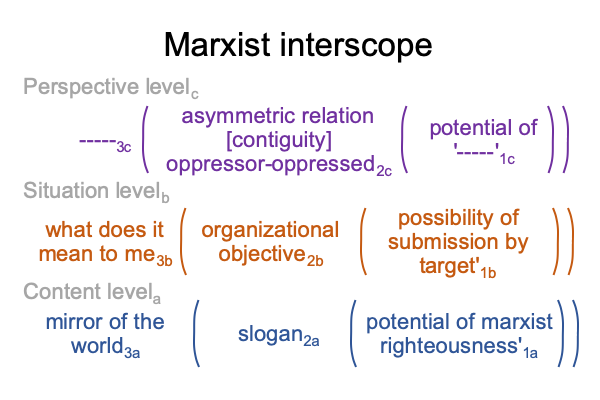
Anyone who agrees speaks, to me3b, in discourses that Lacan labels, hysteric (for some) and scientific (for others). For the most part, I find it hard to tell the difference. I suppose the label depends on the slogan2a. Each slogan2a addresses the one who asks what does this mean to me3b.
“Me3b” is a placeholder, virtually situating the person’s reflection3b in the marxist mirror of the world3a.
0030 Oppressed? Or oppressor? Find a location within the abundance of asymmetric relations contained within the organization tierB.
Here is a diagram of the marxist interscope, as far as this discussion sees.
0031 From the masterwork, How To Define the Word “Religion“, one finds that there are three tiers to the presence underlying the word, “religion”.
They are the societyC, organizationB and the individual in communityA.
The society tierC puts the organization tierB into perspective. The organization tierB emerges from (and situates) the individual in communityA.
Each tier is diagrammed as a three-level interscope.
0032 So, let me talk business.
When an young individual in communityA enters the organization tierB, by going to work, “he” engages a number of asymmetric relations.
How does a young personA navigate these relationsB?
Obviously, the individual in communityA relies on what “he” has been taught.
0033 American classical liberals teach that the individual should have a dream2a.
French classical liberals instruct the individual with tropes about equality, freedom and human brotherhood2a. These expectations2a encourage asymmetric business relations to be “win-win”.
Marxist (il)liberals indoctrinate slogans raising awareness of how asymmetric relations between individuals somehow cause (are contiguous with) systemic oppression2a.
0034 Liberalism offers a dream. Marxism offers a nightmare. Choose your false consciousness.
0035 Hazony describes the pairing as a dance. In this dance, one party negates the other. Thus, the dance is more like the mating ritual between the male and the female praying mantis. The dance ends when liberalism gets devoured as food for the fertilized egg sacs of marxism. Afterwards, an all-consuming fecund marxism dies from her own contradictions, in the winter of her totalizing reign.
0036 Why do I say this?
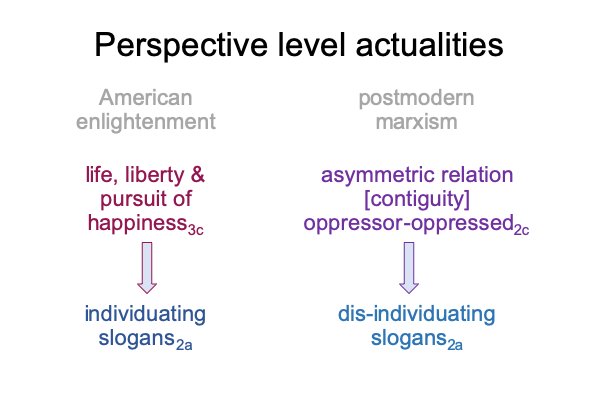
Compare the perspective-level actualities2c for American enlightenment and postmodern marxism.
Figure 10
0037 When the American enlightenment is reflected in the mirror of the world3a, slogans2a call for individuation1b. The asymmetric relations characterizing the organization tier are depicted as opportunities and hazards for fashioning a dream2a based on one’s talents and dispositions1a. When confronted with oppressors, the individual should learn how to detect, avoid and escape. When confronted with mentors, the individual should figure ways to flourish.
0038 Indeed, in America, opportunities1b for success are manifold, ask any movie actress2b promoted by the notorious Harvey Winerock, who turns out to be a postmodern marxist2a,b,c.
In contrast, millions of less-promoted actresses now live in movies of their own, the comedies and tragedies of life in the family2aB, the traditional portal to the organization tierB. For every one actress who reaches an accommodation2b with Harvey, by playing through his disgusting game1b, millions of women discover that the asymmetric relations inherent in the family realize2b their dreams2a.
Who should be teaching whom?
Surely, a Hollywood actress stands in asymmetric relation to innumerable mothers, among others.
So, what does she preach?
Marxist slogans2a?
Why?
In order to attain her dream2b, she is required to become so oppressed2c that she cannot recognize herself as an oppressor2c. She lives out the scientific truth of marxism2c. She submits1b and receives both rewards and marxist illumination2b.
0039 Why are so many civic institutions of American liberalism now controlled by marxists?
The marxist perspective translates the asymmetric relations of the organization tierB into the languages of oppressor and oppressed. Mirroring this perspective2c, slogans2a emerge from a righteousness1a that demands submission of the oppressors1b. One party in all asymmetric relationsB is already guilty of oppression1a on the basis of participation in the system. That party cannot be the marxist, who represents the oppressed.
By definition, the oppressed2c, such as Harvey Winerock and the Hollywood actress, are exempt because each is a marxist occupying a powerful position in a once civic, now marxist, institution. Each, in his and her own way, is a victim in an asymmetric relation with a more powerful individual.
For the actress, that more powerful individual is Harvey.
For Harvey, that more powerful individual is the one who bought his soul.
0040 Harvey Winerock is the poster boy of the marxist endgame.
Here is a character at home with the cruelty of the organization tierB, where asymmetric relations among individuals is contiguous with systemic oppression. Harvey stands as a gatekeeper for the studios of Hollywood. He is a gargoyle. Actresses and actors must speak the proper slogans2a and submit to the proper humiliations1b in order to pass into the bewitched enclave where every asymmetric relation stinks of systemic exploitation. Welcome to an institution filled with marxists.
0041 Harvey lives the marxist dream.
Until, of course, he does not.
Why?
Others can play the game. The organization tierB changes, every so slightly. The identification of oppressor and oppressed2c shifts out of his favor. Harvey and the actress point fingers in a house of mirrors.
0042 Hazony writes of marxism as the end of democracy.
It is really the end of sanity.
Why do French liberals (aka, “old time democrats”) and American liberals (aka, “tea party republicans”) find common cause in 2020?
They both gaze into the house of mirrors that is postmodern modernism.
There is one encouraging feature about the current scene. American academics, hatching the mantis eggs of the Frankfurt school, succinctly articulate their ever-expanding agendas. Hazony comes close to appreciating the paradox, where any asymmetric relation within the organization tierB may be interpreted as systemic oppression2c. If this actuality2c is true and if the organization tierB is full of asymmetric relations (not just full, but bursting with them), then systemic oppression2c is everywhere, except for once-liberal institutions under the control of marxists2b.
0043 What a joke.
InstitutionscC contextualize organizationsB. InstitutionscC justify organizationsB on the basis of righteousness2a. Marxists act as if they are institutionscC without the trappings of an organizationB. Yet, organized they are. They demand sovereign power3b in order to achieve the organizational goals2b that actualize their slogans2a. Harvey Winerock and the movie actress both exemplify the exceptional character of marxists. They are exempt from the marxist critique2c because they self-identify as marxists.
Harvey is promoted by other marxists within the studio system, just as homosexual priests promote their confreres, actresses promote their marxist causes, and public school teachers protest for better wages, in order to get better working conditions. No, nobody here engages in asymmetric relations that characterize the organization tierB. Instead, the avatars of the “be little men” movement say that men must become aware how systemic oppression is built into their life, their liberty and their pursuit of happiness.
No, marxists cannot see their reflections in the mirror of the world3a, because their illumination2c is supposed to be reflected in the mirror of the world3a. They see their illuminance2c, not themselves, in their slogans2a.
0044 Academic postmodern marxist disciplines are inquiries into how this or that asymmetric relation in the organization tierB somehow causes (is contiguous with) a relation between oppressor and oppressed2c. Marxists destroy once-liberal civic institutions from within, simply by identifying and promoting others who are self-identified victims (and extollers2a) of particular types of systemic oppression2c. Indeed, their organizational objectives2b force others into submitting1b to slogans2a that assign guilt for participation in systemic oppression1a.
0045 Ultimately, sovereign power3b is required in order to promulgate their organizational objectives2b. And, this is the ultimatum that Hazony fears. What happens when marxists gain control of the levers of state power?
Yoram Hazony’s article is an intimation of what will be exposed when conservative, Christian and nationalist citizens challenge Big Government (il)Liberalism, the hidden and the complete perversion of the Enlightenment tradition.
0046 Five related works are available at www.smashwords.com.
A Primer on the Category Based Nested Form
A Primer on Sensible and Social Construction
How To Define the Word “Religion”
A Primer on the Family
A Primer on the Organization Tier (First and Second)