Category Archives: The Evolution of Talk
The “evolution of talk” covers the evolution of the human capacity for language as well as the modes in which that capacity is expressed. Aspects are discussed in chapters 1,2 and 7 of An Archaeology of the Fall.
Man and Sin by Piet Schoonenberg (1964) 2.3 LA
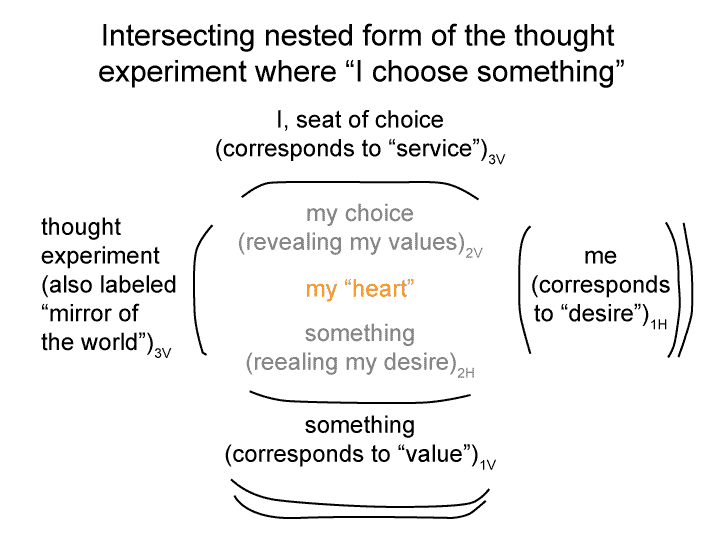
[Plus, there are three types of desire: the desire to approach, the desire to avoid, and the desire to not be bothered.
I cannot approach my inadequacy in fulfilling the laws as interpreted by the Saducees and Pharisees2a.
I cannot avoid my inadequacy in fulfilling the laws as interpreted by the Saducees and Pharisees2a.
But, I can desire not to be bothered by it.
Weirdly, this supports the modern notion of “freedoms” as negative rights. The original American constitution establishes the freedom not to be constrained by the state (religion).]
Man and Sin by Piet Schoonenberg (1964) 2.3 KZ
[What does this mean?
‘Something2a’ was my inadequacy in fulfilling the laws as interpreted by the Saducees and Pharisees2a.
What does that have to do with desire1a?
Desire1a is a possibility inherent in me1a, but it is not the only possibility.]
Man and Sin by Piet Schoonenberg (1964) 2.3 KW
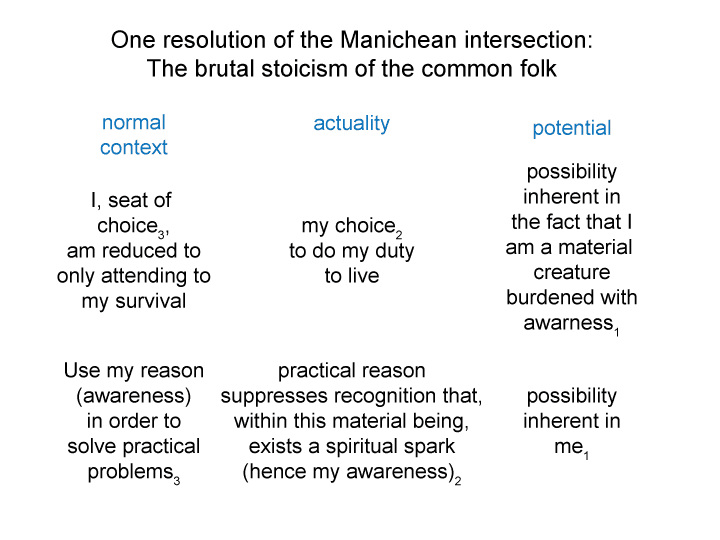
[Obligations went from responsibilities to words.
The words of the Law put the majority in bondage.
Common folk (the so-called “deplorables”) were required to meet traditional family and tribal obligations.
They were never adequate when it came to ritual purity. They were good people, but they were cast as losers
All they could hope for was to avoid accusations of thinkanti-object, that is, rumors that would ruin one’s life and relations.
Does that sound vaguely familiar for today’s (2017) America?]
Man and Sin by Piet Schoonenberg (1964) 2.3 KT
[Also, the obligations of tribe and family are particular.
My particular tribe and family may have a tendency to micromanage. Petty demands add to time-honored expectations.
Plus, there will always be a slacker in the house.
Plus, the family and tribe may have a debilitating tendency to blame all their woes on one person. Everyone wants to be blameless, so nothing gets done.
The Law of Moses mitigated that.
The Law of Moses held out the possibility of reward (or, at least, not punishment) for the individual with initiative, despite family and tribal obligations.]