Category Archives: The Evolution of Talk
The “evolution of talk” covers the evolution of the human capacity for language as well as the modes in which that capacity is expressed. Aspects are discussed in chapters 1,2 and 7 of An Archaeology of the Fall.
Man and Sin by Piet Schoonenberg (1964) 2.3 LV
[How is this possible?
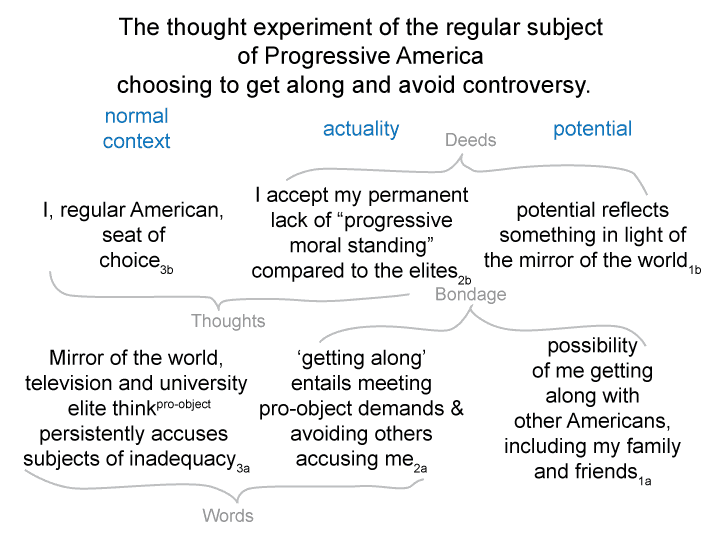
Americans are ‘free’. However, voters have consistently chosen ‘somethings2a’ that have empowered the Central Government (State and City governments no longer rule independent of the Center).
Or have they?
Their votes against the aggressive (infra)sovereign party go to the the other party.
This other party takes the passive common folk stance of meeting ritual demands in order to avoid accusations by the (infra)sovereign party.
Big Government Liberalism wins either way.
How crazy is that?]
Man and Sin by Piet Schoonenberg (1964) 2.3 LT
[Turn on Progressive TV to see a parade similar to the Second Temple.
The elites of Big government Liberalism demand ritual purity. They demand that the average citizen give up “his” stuff. They say that the average citizen does not get along. They have buckets of nasty labels for the deplorables.
They say that the average citizen is intolerant unless “he” conforms to the multitudinous ritual decrees of the Progressive state, universities and various other sovereign-loving affiliations.]
Man and Sin by Piet Schoonenberg (1964) 2.3 LQ
[Since the Second Temple Law was complicated and self-contradictory, accusations could always occur (especially if one attracted attention).
This threat of accusation made it easy for common folk to choose a lack of self worth in order to avoid catastrophic accusations.]
Man and Sin by Piet Schoonenberg (1964) 2.3 LK
[Consider histories of Franklin Roosevelt written in the 20th century (7700s U0’).
Not one assessed the economic consequences of Roosevelt’s tragic and capricious presidential leadership.
The Federal Reserve Board caused the Great Depression.
Roosevelt did nothing to stop their madness.
He enhance the Great Depression by supplementing economic with political uncertainty.
Why did America not fall into revolution?
The common folk were still Christian.]
Man and Sin by Piet Schoonenberg (1964) 2.3 LJ
[Modern intellectuals rarely correlate the political rhetoric (words) with economic consequences (bondage).
Indeed, it seems that their job is to produce the words that put the common folk into bondage.]
Man and Sin by Piet Schoonenberg (1964) 2.3 LH
Maybe, the enhanced economic performance of (what later was negatively labeled) “the Christians” permitted the Roman Empire to survive as long as it did.
This conclusion flies in the face of massive tomes, carrying titles like The Rise and Fall of the Roman Empire.]
Man and Sin by Piet Schoonenberg (1964) 2.3 LG
Summary of text [comment] page 83
[Here is a strange claim:
In the late Roman Empire, the converted Jew and the Jesus-worshipping slave may have been marginally more economically productive than the Second Temple Jew and the pagan slave.
Why?
The former were not of this world3a. They were in the world3a but not of it. Therefore, they did not bother with unproductive fantasies2a.]
Man and Sin by Piet Schoonenberg (1964) 2.3 LF
[The New Testament co-opposition of responsibilities3(2()) and freedom2(1) captures a moment of redefinition.
The bondage to the words of the Judaic law ended.
By choosing3b the way of Jesus2b, a converted Jew was more free1a to pursue “his” preferences in selecting responsibilities3a.
Ironically, the less political people of Christ’s way produced more wealth than the very political and wealth-devouring Jewish or Roman elites of the time.]