Man and Sin by Piet Schoonenberg (1964) 2.3 UL
Summary of text [comment] pages 84 and 85
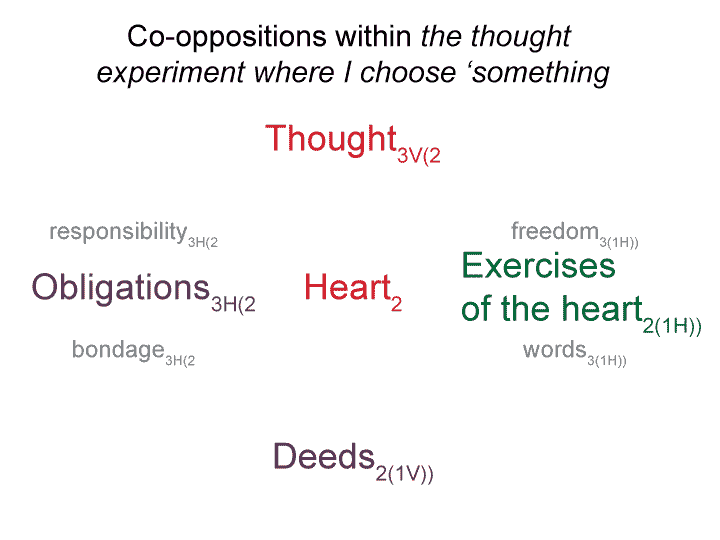
[Law enters through thought3V(2 then influences deeds2(1V)).
Sin enters through words3H(2 then produces bondage2(1H).]
Summary of text [comment] pages 84 and 85
[Law enters through thought3V(2 then influences deeds2(1V)).
Sin enters through words3H(2 then produces bondage2(1H).]
Summary of text [comment] pages 84 and 85
[A second co-opposition composes the vertical axis.
This is: Thought3V(2 and deed2(1V).
This vertical co-opposition intersects the horizontal co-oppositions of either responsibility3H(2 & freedom2(1H)) or words3H(2 & bondage2(1H)).
My heart2 is the single actuality that arises from the congruence of two co-oppositions.]
[Responsibility tends to exclude the normal context belonging to words, and visa versa.]
[Freedom and bondage are exclusively opposed even though they are both exercises of the heart2(1H).
What does this imply?
Since exclusion is a property of the realm of normal context, each of these terms co-oppose an independent normal context.
Freedom2(1H)) co-opposes responsibility3H(2.
Bondage2(1H)) co-opposes words3H(2.]
Summary of text [comment] pages 84 and 85
[Ah, what about the prior models?
Free will is a term that belongs to both the intersections of ‘my heart2’ and ‘what is good and what is bad2’.
Free will associates to the potentials of each vertical axis, something that I may choose1V and conscience1V.
Similarly, free choice belongs to the single actuality of ‘my heart’2 and what is good and what is bad2.]
[Common use of the term ‘free will’ shows that speakers do not readily distinguish between these two associations.
May I? gets confounded with can I?.
One question is theological. The other is practical.]
Summary of text [comment] pages 83 and 84
[What about the potentials underlying the heart2?
‘Free will’ associates with the something that I may choose1V (and by comparison, with consciencespecified1V).
Does ‘free will’ also associate to the grounds of the exercises of the heart2H(1H)) (and by comparison, with ‘the potential inherent in me1H’)?
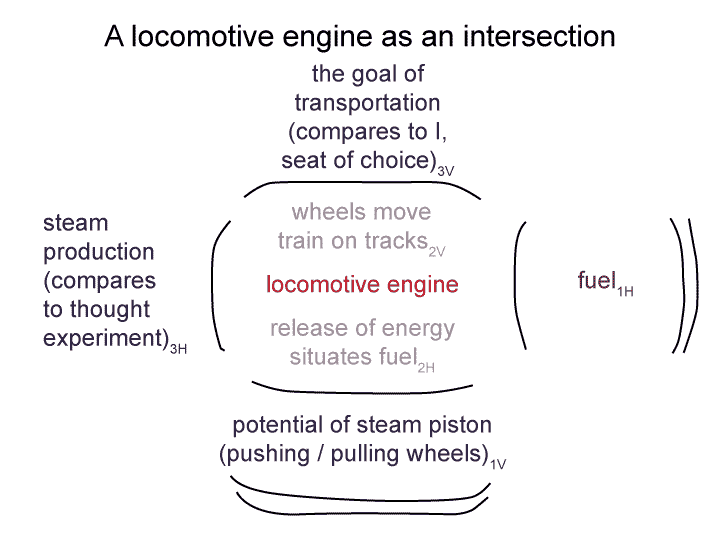
[When a locomotive engine breaks, there are so many issues to consider.
What is the problem? Is it the fuel? Is it the way that the fuel burns? Is it steam production? Is it the working of the steam piston? Is it the connection to the wheels? Why are the wheels turning to move the train? What am I going to do if I cannot move my goods to market?
Does that sound like the travails of a broken heart?]