Man and Sin by Piet Schoonenberg (1964) 2.2 CS-2
[In contrast, non-indoctrinated observers see corruption.
Progressive intervention increases dependency (that is, bondage) and denies responsibility. Progressive interventions substitute words, promises and laws for responsibility. Responsibility is rendered bad, in concert with the slogan-word, ‘entitlements’.
Recipients are entitled. All others are are demeaned whenever they suggest that recipients are not entitled.]
[How does this denial unfold?
Let me first state the method in terms the message underlying the word ‘religion’.
How do Progressives deny the consequences of their programs?
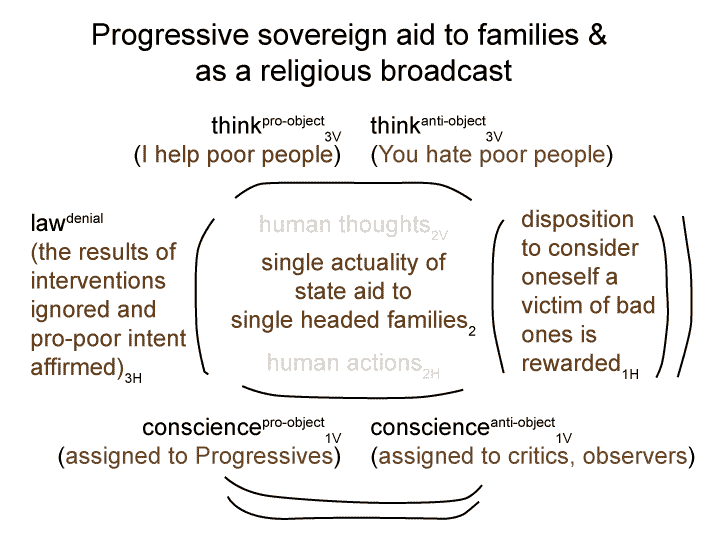
They place intent into the normal context of thinkpro-object3V.
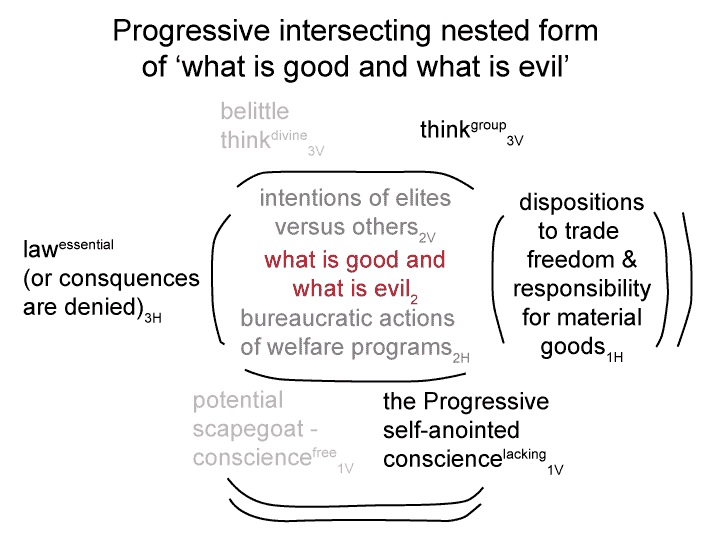
They veil lawessential3H with lawdenial3H.
Remember that the single actuality of the intersection is ‘what is good and what is bad’.
Intentions are good. The bad results are not due to the program itself.
This intersection is then broadcast as the message underlying the Progressive sovereign religion.
The immediate response of any Progressive to those who observe the consequences (and dare to report their observations) of the Progressive ordinate system is simple: “You hate poor people.”]
Summary of text [comment] page 75
[The moment that I try to affirm ‘a good that derives solely from nature’ [that is, from consequences (normal context) and dispositions (potential)], I set myself up to miss the mark, even though I may appear to improve the situation at first.
Why?
When I ‘try to do good’, I inevitably place an actuality into context. That is, I apply ordinates to ‘what I regard as actuality’. These ordinates are projections of ‘what I regard as natural’.
I define consequences and dispositions in terms of ‘what is natural’. When the tragic results start to roll in, I cannot comprehend why things go wrong and why people are distressed.]
[So what did Schoonenberg intend with ‘his use of the word ‘nature’‘?
To me, his arguments point to the horizontal axis of several of the recently discussed intersections.
For example, in ‘the message underlying the word ‘religion’‘, Schoonenberg’s use of the word ‘nature’ points to the horizontal nested form:
Lawessential or Consequences3H( sin and virtue2( dispositions1H))
In the tension between I recognize myself as an image of God and human nature is to participate in divine nature, the horizontal nested form is:
My divine nature to be the seat of choice3H( state of grace or state of self-destruction2( my potential for participation1H))]
[I suspect that the so-called ‘natural’ attempts to access our evolved nature are cultural phenomena.
They are scams, inducing self-destruction.
Why?
Natural ordination cannot be obtained in our current Lebenswelt.
The ordination of talk has changed. Before the first singularity, hand-speech talk held the qualities of reference. After the first singularity, speech-alone talk holds only symbolic qualities. Reference must be projected into words.
So what does ‘the projection of ‘what is natural’’ into words suggest?]
[In our current Lebenswelt, humans no longer have these options, even when the band itself is specialized (say royalty or blacksmiths).
Concupiscence has been unloosed.
To me, this unloosing resonates with Rene Girard’s descriptions of ‘unconstrained mimetic desire’.
Cupid is the god of mimetic desire.
After the first singularity, religious traditions wrestled with concupiscence, at first through thinkgroup (which originally served as thinkpost-first-singularity for a band or a specialization), then through a slow awakening to a trans-thinkgroup, which I label thinkdivine].
[I am not sure what the answer is.
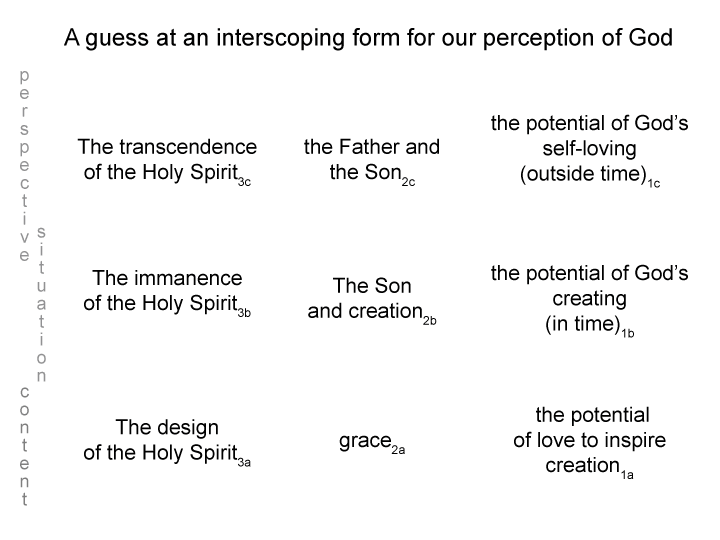
Is Grace somehow related to the design of Creation?
No human can own it. No human lives without it.]